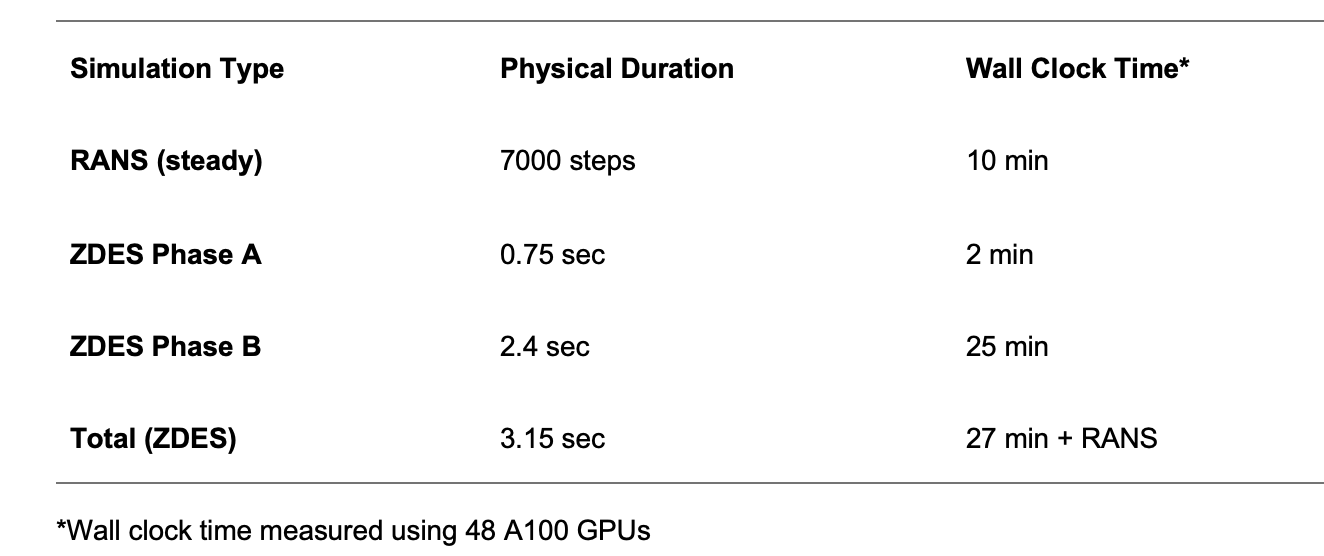
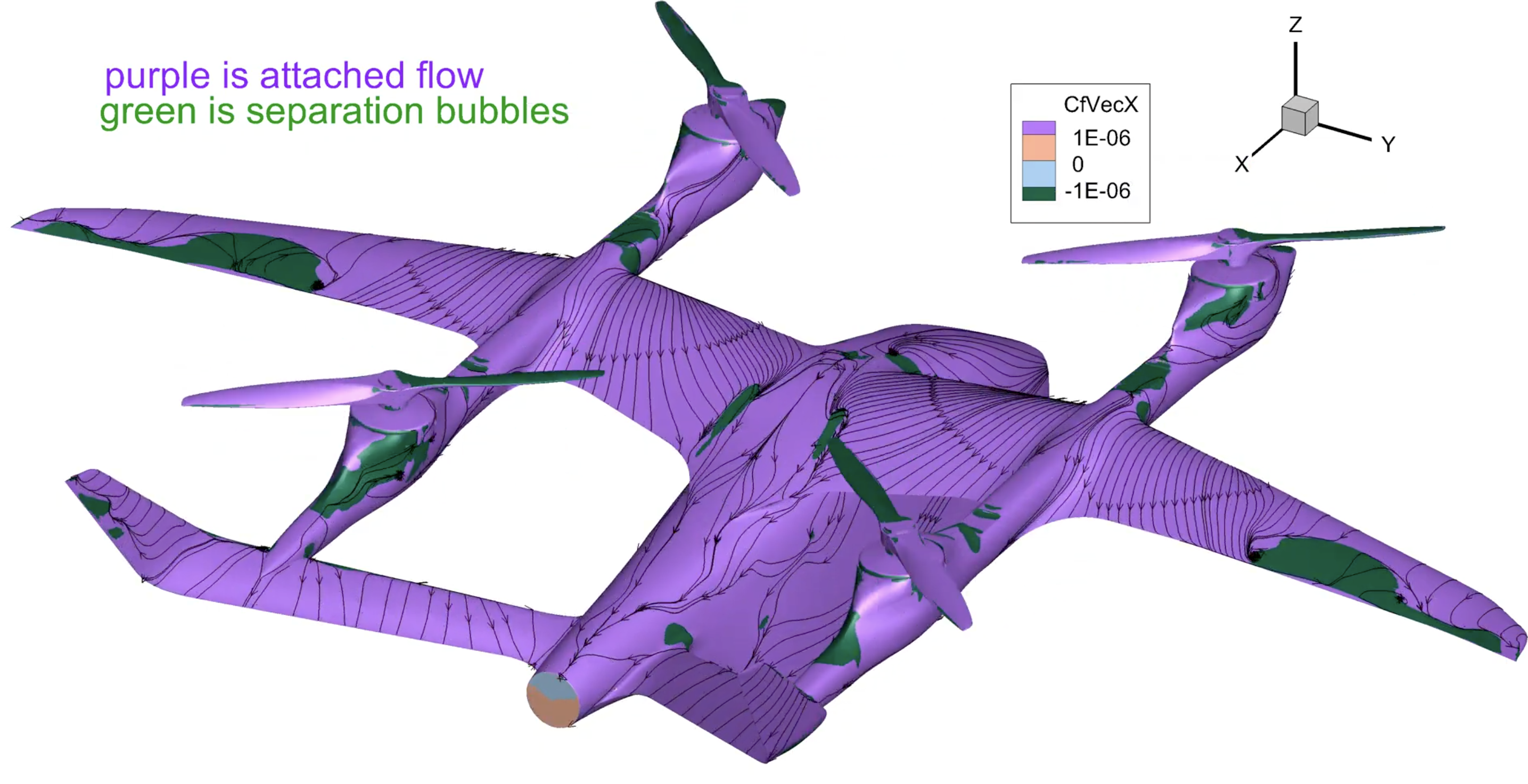
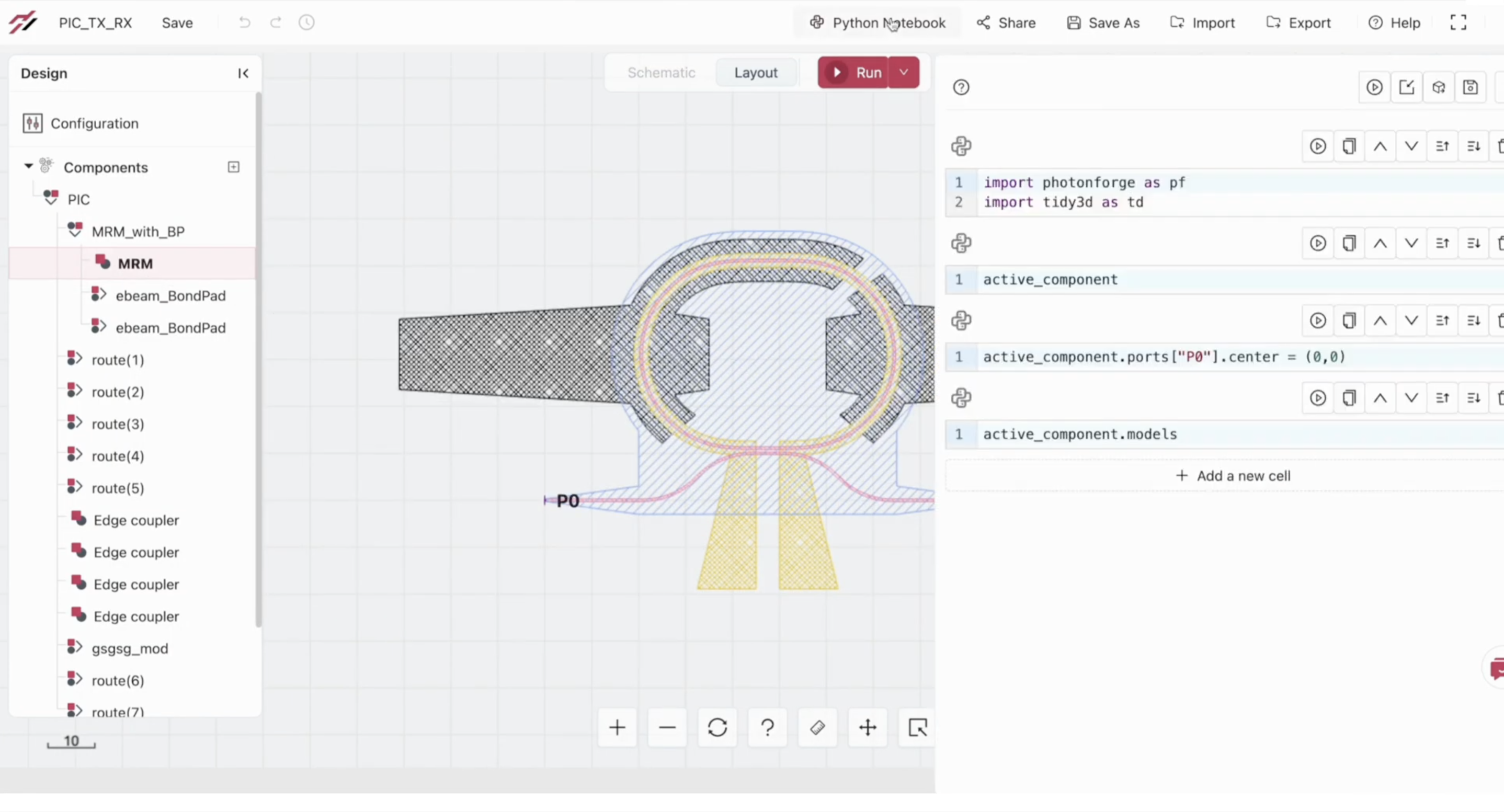
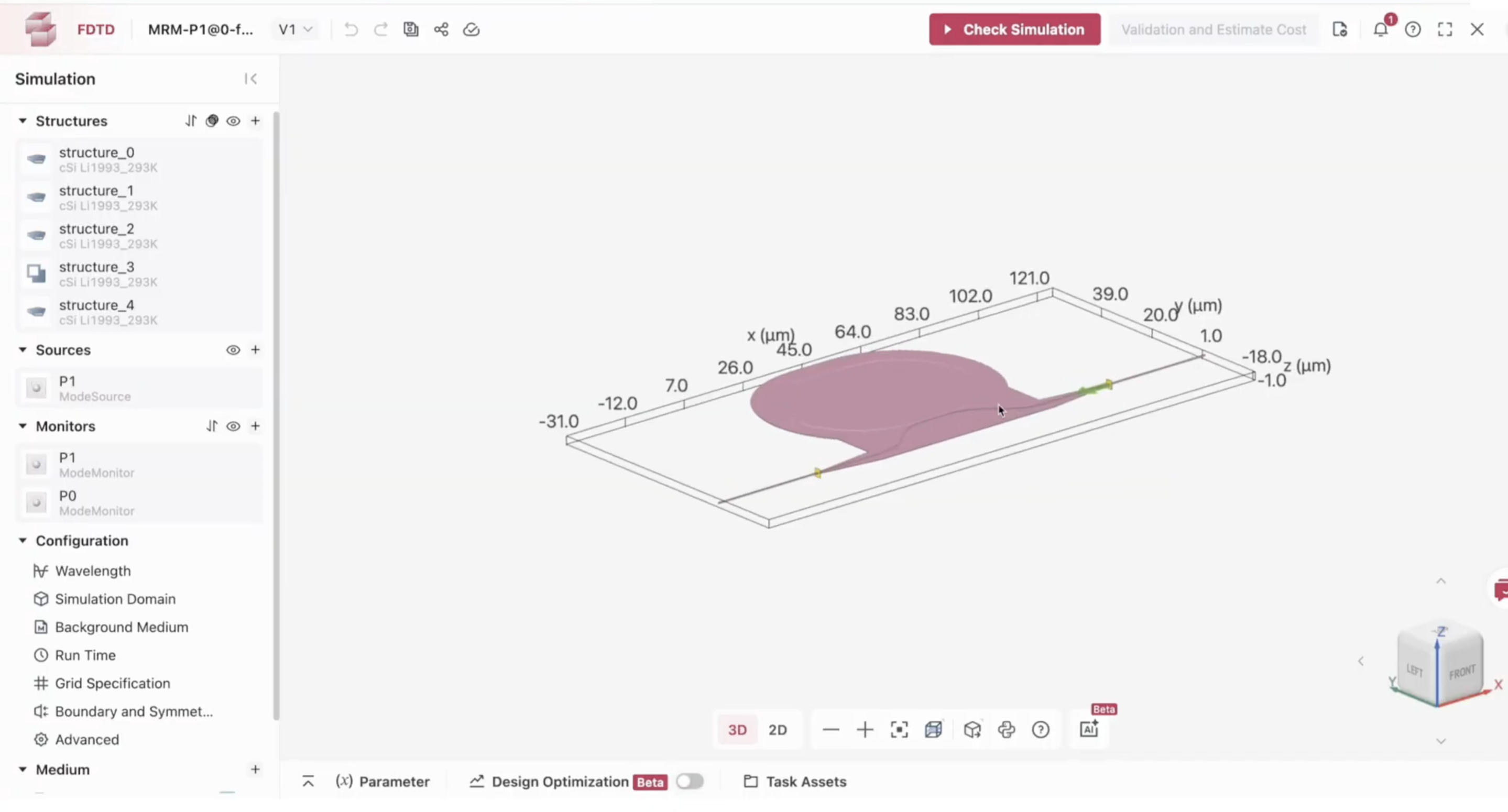
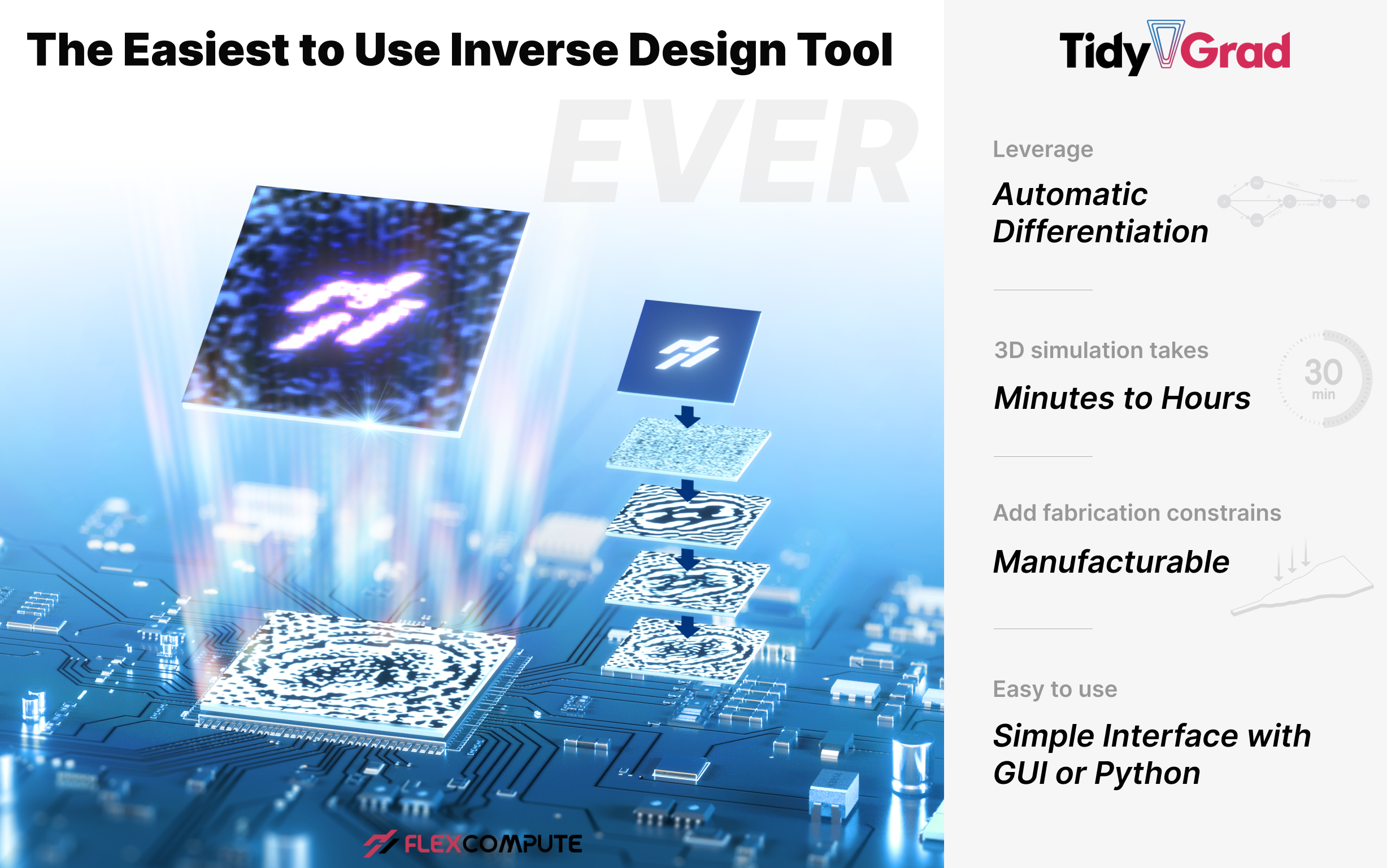
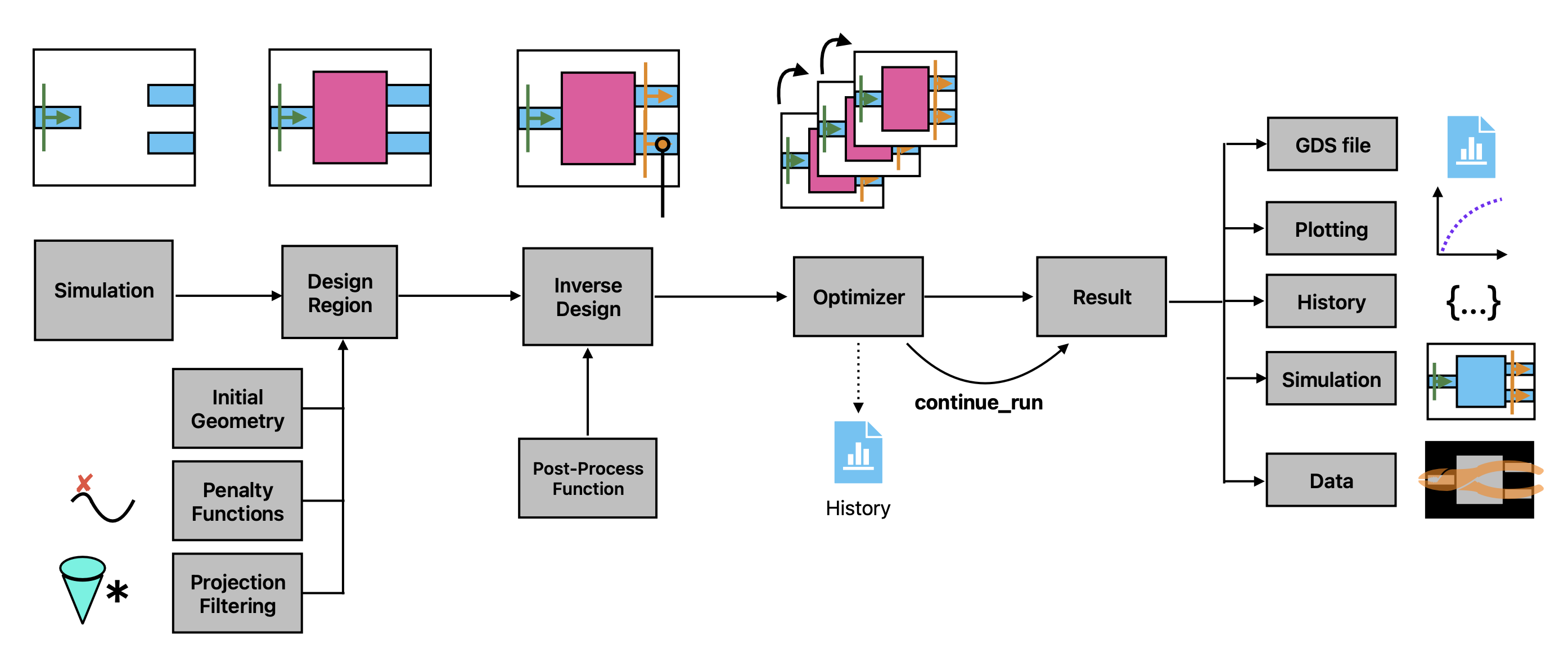
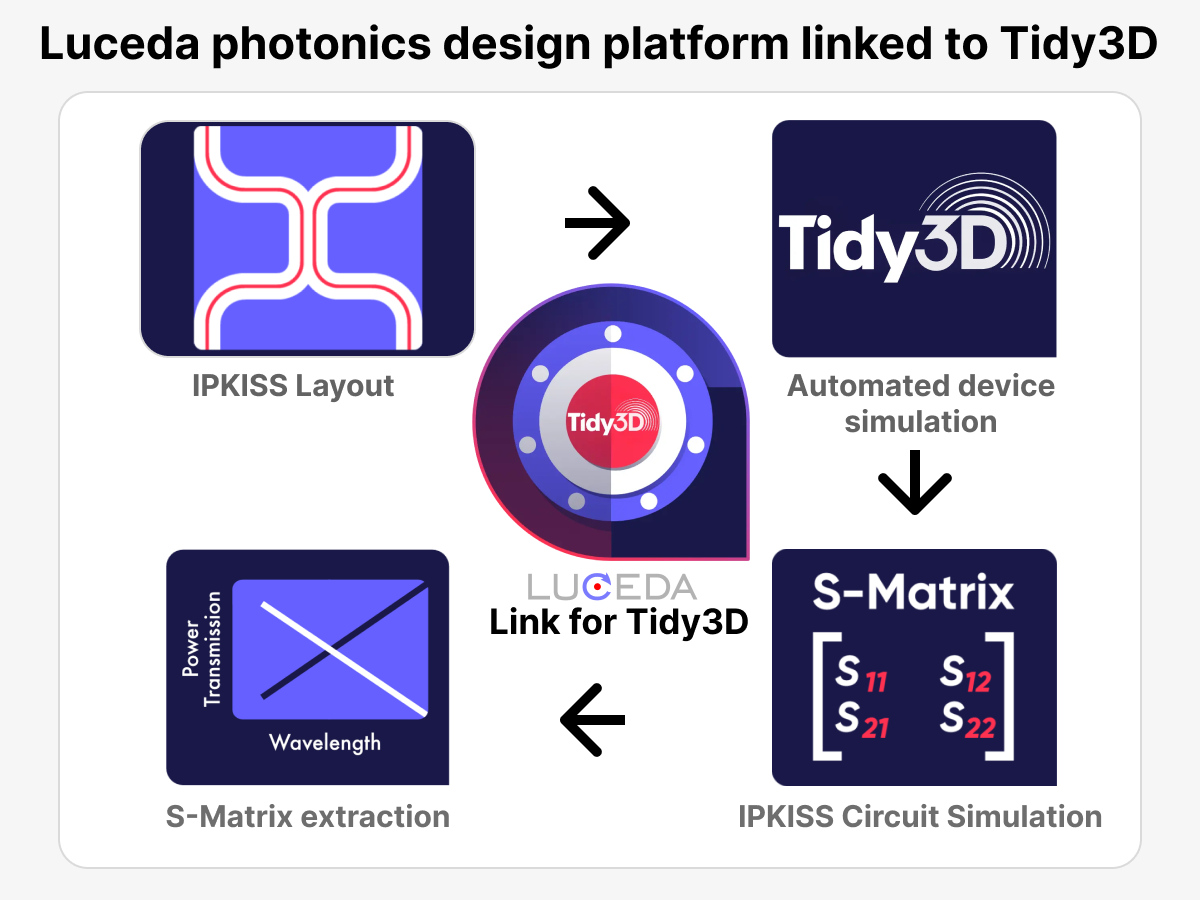
<?xml version="1.0" encoding="utf-8"?><feed xmlns="http://www.w3.org/2005/Atom"><generator uri="https://jekyllrb.com/" version="4.2.2">Jekyll</generator><link href="https://www.flexcompute.com/blog/feed.xml" rel="self" type="application/atom+xml"/><link href="https://www.flexcompute.com/" rel="alternate" type="text/html"/><updated>2026-08-18T20:51:02+00:00</updated><id>https://www.flexcompute.com/blog/feed.xml</id><entry><title type="html">Beyond the Tunnel: Designing the A250 in the Age of Instant Aerodynamics</title><link href="https://www.flexcompute.com/flexcompute-and-beta/nvidiab200/instant-aerodynamics-a250" rel="alternate" type="text/html" title="Beyond the Tunnel: Designing the A250 in the Age of Instant Aerodynamics"/><published>2025-05-27T13:00:00+00:00</published><updated>2025-05-27T13:00:00+00:00</updated><id>https://www.flexcompute.com/flexcompute-and-beta/nvidiab200/designing-the-cx-300-how-instant-aerodynamics-is-shaping-the-future-of-automotive-innovation</id><content type="html" xml:base="https://www.flexcompute.com/flexcompute-and-beta/nvidiab200/instant-aerodynamics-a250"><![CDATA[<p>Wind tunnels have long been a cornerstone of aerospace engineering, providing direct measurements of forces and moments on physical models, with real-world fluid dynamics faithfully reproduced by nature itself. However, full-scale, production-ready models are often impractical to test—both due to cost and because, by that stage, it’s too late to meaningfully impact the design. While a well-executed wind tunnel campaign yields invaluable data, modern Computational Fluid Dynamics (CFD) offers powerful and complementary advantages.</p> <p>With a tool like Flexcompute’s Flow360, we can simulate full-scale, state-of-the-art geometries quickly and accurately. Built for GPU-native performance, Flow360 enables us to run highly complex simulations in a matter of minutes—dramatically accelerating our design cycles. This speed and robustness allow for rapid result comparisons, deeper design confidence, and the creation of high-value aerodynamic performance databases critical for our flight controls and simulation teams.</p> <p>Beyond forces and moments, CFD unlocks rich insights into the underlying physics of flight, providing a level of flow visualization that few other methods can match</p> <p class="align-center"><br/><img src="https://lh7-rt.googleusercontent.com/docsz/AD_4nXfITu0UC1gcfhpLEH5AosWa6r5-gDrPh7Fxd3MUhSh2KKIo5uQaDrwUadR0qv8WLZtjIz6PpT2Po5L_Hzn8-1Er9xArW8ho4VL0z0LbAostxRp0h4KE1ctyWMKjQ5LsFGMLObuMKdrwSarxEDhI4A?key=WgfI0zjAEL-d7nQfEv1sCiTF" alt="" width="624" height="436"/><br/><strong>Figure 1: BETA Technologies subscale A250 model</strong><br/></p> <p>As a vertical takeoff and landing (VTOL) vehicle, the ALIA A250 must transition seamlessly between vertical and horizontal flight. This shift—from thrust-borne to wing-borne flight and back—creates complex aerodynamic interactions. Wake flows from the lifting propellers wash over the wings and impact downstream propellers, making it critical to capture and understand these effects with our computational tools.</p> <p>Wind tunnel testing clearly revealed aerodynamic interference between the lift propellers and the airframe, but it couldn’t fully visualize the underlying flow phenomena in the detail we wanted. By replicating key test points in CFD, we unlocked a deeper understanding of the flow physics—and demonstrated Flow360’s ability to accurately reproduce aerodynamic interactions and their impact on forces and moments.</p> <p class="align-center">Furthermore, CFD allows us to run the test points at full-scale Reynolds numbers, with production lift propellers and production geometry.<br/><br/><img src="https://lh7-rt.googleusercontent.com/docsz/AD_4nXcrW9JhQe44JGevAQJkKN-miPeybcLGlcDLWHLo8YOOFzNNk5oJoPCjxguL4hsneG3NEmiU4ux2WgKf5ttkXS7M1wg55wrfr-2lC82IOMwbqgPBFsnbMbMTc0hznIMth3dZVKFtJ_QSfKTCHu-x3iQ?key=-lel5J7t9HMwJpUxwMR5RA" alt="" width="624" height="343"/><br/> <strong>Figure 3: Time history of force and moment breakdown on various A250 components.</strong></p> <p>By breaking down forces and moments component by component, tracking their evolution over time as the propellers rotate, and combining this with:</p> <p>● Surface skin friction visualizations</p> <p>● Streamline flow data</p> <p>● Q-criterion isosurfaces (to map vortex and downwash behavior)</p> <p>We gain insights into some of the most aerodynamically interesting parts of the flight envelope, with much of the post-processing taken care of directly within Flow360.</p> <p class="align-center"><img src="/uploads/screenshot-2025-05-27-at-7-49-27-am-1.png" alt=""/><br/><strong><br/>Figure 4: Surface streamlines showing recirculation regions</strong><br/><br/><br/><img src="https://lh7-rt.googleusercontent.com/docsz/AD_4nXdRyiUdU_za2tOLNf5otgxg0J_LhWLdHJassTM9d8V35CMH4svYhg0j-l90YKL96CpezgMMkug_VrLVl0QehahG7vlqD_yCsSWiHew7kRI9D-TD7RnZwA_Uk2nH2_yJ9LqT6Ti7JLYk_biKzhu8kT0?key=WgfI0zjAEL-d7nQfEv1sCiTF" alt="" width="624" height="407"/><br/><strong>Fig-5: Snapshot of Q-criterion isosurface revealing wake shedding</strong></p> <h2 id="what-makes-these-simulations-so-challenging"><strong>What Makes These Simulations So Challenging?</strong></h2> <p>These CFD simulations are far from simple. They feature:</p> <p>● Fast-spinning propellers, requiring small time steps to capture transient flow accurately</p> <p>● Wake propagation, needing long simulation times to stabilize</p> <p>● Highly refined mesh zones, particularly between interacting components, leading to massive mesh sizes—up to 119 million nodes</p> <p>● Stringent accuracy demands, including many subiterations per time step to reach convergence by at least two orders of magnitude</p> <p>● Advanced turbulence modeling, using the latest Spalart-Allmaras DDES implementation combined with low numerical dissipation algorithms</p> <p class="align-center"><img src="https://lh7-rt.googleusercontent.com/docsz/AD_4nXcoYQoMAg9IUoc9EVo3MV0HC7Gm8F65kC00UXDwLlf3-ZFgB91eagdGa8Iv9tQ0diUpDX-qVCN5U3geylvUuBwoyGMynwmttBTpVp0erYkFFU-fW7Brms1IHDcWSHfSkWE79CIlAyZ7u1DLDTtg0wU?key=WgfI0zjAEL-d7nQfEv1sCiTF" alt="" width="624" height="555"/><br/><strong>Fig-6: Slice through y=0 Symmetry plane showing volume mesh refinement regions.</strong></p> <h2 id="performance-at-the-cutting-edge"><strong>Performance at the Cutting Edge</strong></h2> <p>Flow360 enables us to run fully time-accurate DDES simulations with 119 million nodes—achieving under 7 minutes per propeller revolution using just 8 NVIDIA B-200 GPUs on Flexcompute hardware. That’s the speed and fidelity needed to drive real design decisions.</p> <p>That’s speed and fidelity we can build on.</p> <h2 id="why-it-matters"><strong>Why It Matters</strong></h2> <p>Running these simulations early allows us to:</p> <ul> <li>Avoid costly redesigns</li> <li>Accelerate iteration cycles</li> <li>Deliver better, safer aircraft faster than ever before</li> </ul> <p>With this level of insight, we can detect aerodynamic issues before a single part is manufacture, fixing them early in design or addressing them through flight control logic long before first flight. This predictive capability reduces rework, cuts cost and keeps us on schedule. CFD isn’t just a support tool anymore. It’s a core enabler of the next generation of flight.</p>]]></content><author><name>Will Hewson: Aerodynamics and performance engineer at Beta Technologies and Jim Bungener: Application Engineer at Flexcompute </name></author><summary type="html"><![CDATA[In this deep dive into next-generation aircraft design, Beta Technologies and Flexcompute reveal how the A250 eVTOL was developed using cutting-edge Computational Fluid Dynamics (CFD) and high-fidelity simulations powered by Flow360. Moving beyond traditional wind tunnel reliance, this article explores how GPU-native solvers, advanced turbulence modeling, and rapid iteration enabled the team to optimize complex aerodynamic transitions in vertical takeoff and landing flight. Learn how real-time aerodynamic insight is reshaping aerospace design, reducing risk, and accelerating innovation—before a single part is ever built.]]></summary></entry><entry><title type="html">Flexcompute Co-Founder Shanhui Fan Elected to National Academy of Sciences</title><link href="https://www.flexcompute.com/blog/2025/04/30/shanhui-fan-elected-to-national-academy-of-sciences" rel="alternate" type="text/html" title="Flexcompute Co-Founder Shanhui Fan Elected to National Academy of Sciences"/><published>2025-04-30T15:00:00+00:00</published><updated>2025-04-30T15:00:00+00:00</updated><id>https://www.flexcompute.com/blog/2025/04/30/flexcompute-co-founder-shanhui-fan-elected-to-national-academy-of-sciences</id><content type="html" xml:base="https://www.flexcompute.com/blog/2025/04/30/shanhui-fan-elected-to-national-academy-of-sciences"><![CDATA[<p class="align-center"><em>​Renowned photonics researcher and Stanford professor honored for pioneering work in computational electromagnetics and nanophotonics</em></p> <p><strong>[Boston, April 30, 2025]</strong> – Flexcompute proudly congratulates <strong>Dr. Shanhui Fan</strong>, co-founder of Flexcompute and a world-renowned expert in photonics and electromagnetism, on his election to the <strong>U.S. National Academy of Sciences (NAS)</strong>, one of the highest honors in American science.</p> <p>Dr. Fan is a professor of electrical engineering and applied physics at Stanford University and has played a pivotal role in shaping the theoretical and computational foundations of modern photonics. His research spans <strong>nanophotonics, photonic crystals, metamaterials, plasmonics and solar energy conversion</strong>, with a strong emphasis on computational methods, a core strength that he brought to Flexcompute.</p> <p>As <strong>co-founder of Flexcompute</strong>, Dr. Fan helped establish the company’s mission to revolutionize scientific computing, delivering breakthrough simulation performance for electromagnetics, fluid dynamics and beyond. His vision continues to drive Flexcompute’s innovation at the intersection of physics and high-performance computing.</p> <p>Dr. Fan earned his Ph.D. from the <strong>Massachusetts Institute of Technology</strong> under the mentorship of John Joannopoulos. With an h-index of 177, he is one of the most highly cited researchers in his field.</p> <p>“Shanhui’s election into the National Academy of Sciences is not only a recognition of his extraordinary scientific achievements, but also a validation of the deep scientific principles that guide our work at Flexcompute,” said Vera Yang, Flexcompute Co-Founder and President. “We’re honored to have him as a co-founder and collaborator.”</p> <p>Dr. Fan is one of 120 new U.S-based members elected in 2025 for distinguished and continuing achievements in original research. For more information on the NAS 2025 elections, visit <a href="https://www.nasonline.org/news/2025-nas-election/"><u>nasonline.org</u></a>.</p>]]></content><author><name>Flexcompute</name></author><category term="News"/><summary type="html"><![CDATA[Flexcompute congratulates Dr. Shanhui Fan, co-founder and Stanford professor, on his election to the U.S. National Academy of Sciences. A globally recognized expert in photonics and electromagnetism, Dr. Fan has been instrumental in advancing computational methods that underpin Flexcompute’s technology. His election honors a career of groundbreaking research and continued impact on science and high-performance simulation. Learn more at nasonline.org.]]></summary></entry><entry><title type="html">Simulating the DrivAer Model with Flow360: A Comprehensive Guide to CFD Analysis</title><link href="https://www.flexcompute.com/simulating-drivaer-model-with-flow360" rel="alternate" type="text/html" title="Simulating the DrivAer Model with Flow360: A Comprehensive Guide to CFD Analysis"/><published>2025-04-10T15:20:00+00:00</published><updated>2025-04-10T15:20:00+00:00</updated><id>https://www.flexcompute.com/simulating-the-drivaer-model-with-flow360-a-comprehensive-guide-to-cfd-analysis</id><content type="html" xml:base="https://www.flexcompute.com/simulating-drivaer-model-with-flow360"><![CDATA[<p><strong>Introduction</strong></p> <p>In 2024, Flexcompute participated in the AutoCFD4 workshop, where we presented our highly accurate and fast results for the DrivAer model. The AutoCFD4 workshop is an international forum for researchers and practitioners in the field of automotive Computational Fluid Dynamics (CFD). The workshop provides a platform for the exchange of ideas and experiences on the latest developments in automotive CFD.</p> <p><strong>DrivAer Model</strong></p> <p>The AutoCFD4 workshop focuses on two test cases: the Windsor model and the DrivAer model. However, it’s the DrivAer model that generally garners more attention, primarily because it’s a reasonably accurate representation of a real-life commercial car It is a complex geometry that is used to benchmark the accuracy and efficiency of CFD solvers. While the geometry, boundary condition, and computation grid are provided by the committee, the workshop offers interesting insights into various turbulence models and numerical schemes.</p> <p><img src="https://lh7-rt.googleusercontent.com/docsz/AD_4nXemz_-HROTwb10IshN3QNeiq2KAhnvchGeB7yqf0P0LjuVuziox1arKMRmFWTThB_CQU65SR0_xDTMC5OJHSCoO4eogjPFxATiKlTZY9FpP9W-jjXtm0tCMsbqqewMgV4b08dz4?key=QEeXc9-ry05VnyTeRduDVLDy" alt="" width="624" height="351"/></p> <p><strong>Speed and Accuracy of Flow360</strong></p> <p>Traditional CFD tools require days or even weeks to perform a simulation of an automotive geometry. In contrast, Flow360 requires only 10-15 min for a RANS simulation and 1-2 hours for a DDES simulation of the DrivAer model with the committee-provided grid. With this speed, CFD engineers working on Formula 1, commercial cars, or sports cars no longer need to wait for lengthy periods to evaluate design changes. Design iterations can be done at a much faster pace, with the advantage of high accuracy of DDES simulations. Flow360’s accuracy aids automotive companies in making informed design decisions, while its speed significantly reduces time for design cycles, resulting in faster time-to-market.</p> <p><img src="https://lh7-rt.googleusercontent.com/docsz/AD_4nXc4kUVyjoQub53X956LminGvXm_uZG9Fepuuhg-HR8_rwlybKoxyDlB-M9zfNm3Ot_TJ9iKNbP7bqjBvdjmwGT4tYBKz25JeJsd3f7XavJrog0MsOgouVpeYztJkzReKF_pg2gzTA?key=QEeXc9-ry05VnyTeRduDVLDy" alt="" width="624" height="215"/></p> <p>A comparison of Flow360’s DDES results for the DrivAer model with the test performed in the Pininfarina wind tunnel shown above highlights the capability of Flow360. For a CFD tool to be used in the rigorous design and optimization of automotive, it’s essential to capture complex flow features including corner flow, origin and evolutions of vortices, and tiny wake structures. Without this capability, it is challenging to determine whether a marginal design change is acceptable or not. Flow360’s accuracy with the combination of speed exactly addresses this concern by providing an efficient solution.</p> <p><strong>Conclusion</strong><br/>Flow360’s remarkable speed, coupled with the high accuracy of its results, showcases its potential to revolutionize automotive CFD workflows. We invite you to experience the Flow360 advantage today. <a href="https://www.flexcompute.com/contact/">Talk to an expert</a> to learn more about Flow360.</p>]]></content><author><name>Flexcompute</name></author><category term="automotive"/><category term="AutoCFD4"/><summary type="html"><![CDATA[Introduction In 2024, Flexcompute participated in the AutoCFD4 workshop, where we presented our highly accurate and fast results for the DrivAer model. The AutoCFD4 workshop is an international forum for researchers and practitioners in the field of automotive Computational Fluid Dynamics (CFD). The workshop provides a platform for the exchange of ideas and experiences on the latest developments in automotive CFD. DrivAer Model The AutoCFD4 workshop focuses on two test cases: the Windsor model and the DrivAer model. However, it’s the DrivAer model that generally garners more attention, primarily because it’s a reasonably accurate representation of a real-life commercial car It is a complex geometry that is used to benchmark the accuracy and efficiency of CFD solvers. While the geometry, boundary condition, and computation grid are provided by the committee, the workshop offers interesting insights into various turbulence models and numerical schemes. Speed and Accuracy of Flow360 Traditional CFD tools require days or even weeks to perform a simulation of an automotive geometry. In contrast, Flow360 requires only 10-15 min for a RANS simulation and 1-2 hours for a DDES simulation of the DrivAer model with the committee-provided grid. With this speed, CFD engineers working on Formula 1, commercial cars, or sports cars no longer need to wait for lengthy periods to evaluate design changes. Design iterations can be done at a much faster pace, with the advantage of high accuracy of DDES simulations. Flow360’s accuracy aids automotive companies in making informed design decisions, while its speed significantly reduces time for design cycles, resulting in faster time-to-market. A comparison of Flow360’s DDES results for the DrivAer model with the test performed in the Pininfarina wind tunnel shown above highlights the capability of Flow360. For a CFD tool to be used in the rigorous design and optimization of automotive, it’s essential to capture complex flow features including corner flow, origin and evolutions of vortices, and tiny wake structures. Without this capability, it is challenging to determine whether a marginal design change is acceptable or not. Flow360’s accuracy with the combination of speed exactly addresses this concern by providing an efficient solution. ConclusionFlow360’s remarkable speed, coupled with the high accuracy of its results, showcases its potential to revolutionize automotive CFD workflows. We invite you to experience the Flow360 advantage today. Talk to an expert to learn more about Flow360.]]></summary></entry><entry><title type="html">Flow360 GPU Ultra-Fast Speed AutoCFD4</title><link href="https://www.flexcompute.com/technicalblog/2025/04/07/AutoCFD4-Flow360" rel="alternate" type="text/html" title="Flow360 GPU Ultra-Fast Speed AutoCFD4"/><published>2025-04-07T21:56:10+00:00</published><updated>2025-04-07T21:56:10+00:00</updated><id>https://www.flexcompute.com/technicalblog/2025/04/07/flow360-gpu-ultra-fast-speed-autocfd4</id><content type="html" xml:base="https://www.flexcompute.com/technicalblog/2025/04/07/AutoCFD4-Flow360"><![CDATA[<p>“In our pursuit of excellence, we don’t compromise one aspect to enhance another.” – Qiqi Wang, Co-founder of Flexcompute and architect of Flow360</p> <p>At Flexcompute, we live by this philosophy. During the <a href="https://autocfd.org/" target="_blank" rel="noopener">Automotive CFD Prediction Workshop (AutoCFD4)</a>, Flow360 showcased its exceptional ability to deliver world class <strong>speed and accuracy—simultaneously</strong>.</p> <p>AutoCFD is an international forum that brings together leading OEMs, universities, and CFD practitioners to benchmark simulations against wind tunnel data on standardized automotive geometries. It’s a proving ground—and Flow360 delivered.</p> <p>While we’re proud to offer the fastest solver (see below), our mission goes beyond speed. <a href="https://www.flexcompute.com/flow360/solution/" target="_blank" rel="noopener">Flow360</a> is an <strong>end-to-end platform</strong> that automates the tedious parts of simulation—geometry cleanup, meshing, setup, and reporting—so engineers can focus on what matters: <strong>innovation</strong>.</p> <hr/> <h3 id="benchmarking-flow360-on-the-drivaer-model"><strong>Benchmarking Flow360 on the DrivAer Model</strong></h3> <p>We focused on the <strong>DrivAer model</strong>, a highly detailed and realistic geometry widely adopted for CFD benchmarking. Provided by the workshop committee, the standardized geometry, boundary conditions, and mesh ensure a level playing field. With comprehensive validation data—pressure taps, velocity probes, and PIV imagery—the DrivAer model is a rigorous testbed, and Flow360 passed with flying colors.</p> <h5 id="drivaer-model"><strong>DrivAer Model</strong></h5> <table> <tbody> <tr> <td><img src="https://lh7-rt.googleusercontent.com/docsz/AD_4nXdhyIpd1CGtIw32xblxpEoNNg9dvRUQEhPMyvdrtwVpNowS6OC9lPxrzvDQB41dA52_WgAKFyuZczJMK7xC1KHNqrAHrnyUOTzwvW6tDGKHhVErSBygE7eSQ3A3hX22SvXAZjuCRQ?key=6Ot2tqcmL1xtCnA89utJCn8U" alt="" width="602" height="339"/></td> </tr> <tr> <td><em>Figure 1: Visualization of an isosurface of Q-criterion for DrivAer model</em></td> </tr> </tbody> </table> <hr/> <h5 id="fast-automated-meshing"><strong>Fast, Automated Meshing</strong></h5> <p>Flow360 includes a powerful, feature-rich meshing tool. For AutoCFD4, it generated a <strong>hex-dominant mesh with 145 million nodes in just 60 minutes</strong>. This meshing workflow is easily automated using our Python API, enabling seamless integration into streamlined engineering pipelines.</p> <table><tbody><tr><td><img src="https://lh7-rt.googleusercontent.com/docsz/AD_4nXfmsBH02-KNdYJOl88toMMEEwg8OJQ0CClwYRWHMrIuMmlK9NdmKeg0K6mh8pSxb_Y_2g5nkp_6kuGcxHEauDUS_7eiN-xF_bqhQpiZg1_Ug9yFc8NQRAJQBYPKVbzlpZDMRP8eQw?key=6Ot2tqcmL1xtCnA89utJCn8U" height="214" width="298"/></td><td><img src="https://lh7-rt.googleusercontent.com/docsz/AD_4nXcri-qBsiAu-lA5bx0aRDZLM83WrOkZJOUqUG8U6wEpFUQ_qAMTdIF-53xKHMc5NB7K46V5SU6CgjcV5ow-aKujMeoNfKt9fci0WHwu2j0c543XCtfFrepbh1evOy5nSHnVKe0-NQ?key=6Ot2tqcmL1xtCnA89utJCn8U" height="213" width="300"/></td></tr><tr><td colspan="2">&nbsp;&nbsp;<em>Figure 2: Visualization of the mesh for the DrivAer model generated with Flow360’s meshing tool</em></td></tr></tbody></table> <hr/> <h3 id="rans-predictions-by-the-time-you-finish-your-coffee-10-min"><strong>RANS Predictions by the Time You Finish Your Coffee (10 Min)</strong></h3> <p>Traditional CFD tools take days to simulate realistic automotive geometries. <strong>Flow360 changes the game</strong>.</p> <p>We completed a full <strong>RANS simulation of the DrivAer model in just 10 minutes on 48 A100 GPUs</strong>—without compromising accuracy. This was made possible by:</p> <ul> <li>A <strong>blended central/upwind scheme</strong> to reduce numerical viscosity</li> <li>A <strong>low Mach number preconditioner</strong> to enhance convergence</li> <li>An <strong>adaptive CFL strategy</strong> for stability and robustness</li> <li>User control over turbulence model coefficients, including an <strong>α₁ adjustment in the K-ω SST model</strong> (set to 0.4 to better capture separation over the roof)</li> </ul> <p>The integrated force predictions from Flow360 showed <strong>excellent agreement with physical test data</strong>, with just <strong>2 drag counts of difference</strong>—a level of accuracy rarely seen at this speed.</p> <p class="align-center"><img src="https://lh7-rt.googleusercontent.com/docsz/AD_4nXeK84gKRdqnZRiz_GqgszM7Jmbc6nf0ny95bDZ6sFZP_OpaYYEA6k_cGqoqVgYgYCUf4pQNPawkMuXN2QhLU4-z6F_Oj_eNhZg6ok9ESbSR3ygHB_nKrdMG2wTPiP4WIn5q6DopcQ?key=6Ot2tqcmL1xtCnA89utJCn8U" alt="" width="624" height="359"/></p> <p class="align-center"><em>Figure 3: Comparison of integrated forces between Flow360 RANS and Test data having only 2 drag count difference</em></p> <hr/> <h3 id="scale-resolved-simulation-by-the-time-you-finish-lunch-37-min"><strong>Scale-Resolved Simulation by the Time You Finish Lunch (37 min)</strong></h3> <p>As OEMs increasingly adopt transient simulations for greater accuracy and faster design cycles, Flow360 continues to push boundaries. One major leap: support for <strong>Zonal Detached Eddy Simulation (ZDES)</strong> using the <strong>Deck-Renard shielding function</strong>, enhancing separation prediction in critical flow regions.</p> <p>For AutoCFD4, we submitted a ZDES simulation using this approach. Total wall time: <strong>just 37 minutes</strong>, including both phases below:</p> <p class="align-center"><img src="/uploads/image-2.png" alt=""/></p> <p><em>Table 1: Simulation Timing Summary | *Wall clock time measured using 48 A100 GPUs</em></p> <p>This two-phase ZDES approach done automatically in sequence with <strong>adaptive time-stepping</strong>:</p> <ul> <li>A coarse time step (5e-3 s, CFL = 50 on a resolved mesh zone) to flush the RANS solution for 0.75 sec—completed in 2 minutes on 48 A200 GPUs<br/></li> <li>A fine time step (1e-3 s, CFL = 10) for the main ZDES run, averaged over the last 2 seconds—completed in 25 minutes on 48 A100 GPUs<br/></li> </ul> <p>All of this, without sacrificing fidelity. Flow360’s ZDES results match physical testing <strong>within 1 drag count</strong>, capturing complex flow physics that engineers can trust.</p> <p class="align-center"><img src="https://lh7-rt.googleusercontent.com/docsz/AD_4nXdsqPy0zvYRIRVNdzcJ4jXOqV4AmtvMir3nkWAOTtiq2Rj5Pqq11TXzhNVTfN0VfPFZih8stJxnKtWgUQIeuvJWx9UVxqyBQ9hNSHa1q7OGmRWvyxv3v424r2gsKG-NI_HXTGUjYg?key=6Ot2tqcmL1xtCnA89utJCn8U" alt="" width="624" height="383"/> </p> <p><em>Figure 8: Flow360 ZDES’s excellent prediction of delta forces prediction between two DrivAer configurations with the Test data</em></p> <h3 id="right-answers-for-the-right-reasons"><strong>Right Answers for the Right Reasons</strong></h3> <p>Physically accurate flow features are essential for design optimization. Many CFD tools struggle to resolve complex flow phenomena, particularly around critical regions like <strong>the A-pillar and side mirror</strong>, where flow separation and downstream vortices significantly impact the pressure distribution on the side window. Flow360’s ZDES results, however, show <strong>close agreement with test data</strong>, validating its ability to capture the true physics of the flow.</p> <table> <tbody> <tr> <td><img src="https://lh7-rt.googleusercontent.com/docsz/AD_4nXe7ngVESdZLtCssfJwb262e5M_mde9Cq1-acEQStJgobBBNwsNqOoVg4UvKOk2au8rSJ2TJDnLzI0XC5BPDasxhx1XnAWCpgYAv1_2gI_MiHjoWDGWtGVssbq-fYo0rpC9mzPdE?key=6Ot2tqcmL1xtCnA89utJCn8U" alt="" width="624" height="312"/></td> </tr> <tr> <td><img src="https://lh7-rt.googleusercontent.com/docsz/AD_4nXcI_3uZhcCWNSNHogRVb-QVBOpLZ7xWYnARErWev0IIgAf-j6YTiOthHz8bFIfLBptTfbI384zrgWshNMrqFtypWF3nuWaI2OufmzO2nca6sdT-wiQNVxSXtyUPiSekX8yW697d?key=6Ot2tqcmL1xtCnA89utJCn8U" alt="" width="664" height="285"/></td> </tr> <tr> <td><img src="https://lh7-rt.googleusercontent.com/docsz/AD_4nXfuZ2iufLasLFiT5WwbQE6hK5uwXcAR1X9J6whvSQjpJguSlVDISe-7_l1-W8K7iCahR0HZw2njdvGB679rYzzKhJfUtzeH3sM-frd3cMMOk_CSPUQ8aEkUf-qbZPN9h-NO7jQn?key=6Ot2tqcmL1xtCnA89utJCn8U" alt="" width="378" height="253"/></td> </tr> </tbody> </table> <p class="align-center"> </p> <p>This high level of accuracy continues along <strong>the symmetry plane of both the upper body and underbody</strong>, where Flow360’s pressure predictions align closely with wind tunnel data. Such consistency reinforces trust in the solver’s reliability for production use.</p> <table> <tbody> <tr> <td><img src="https://lh7-rt.googleusercontent.com/docsz/AD_4nXdfJY1PldQa9POdcIv0pqfWk6rbYkUjlS8iB-VqQCzrxCXfV8OpNmreOIc8goA7hCjxOlcMu2DVe2Ov-tewAmRKC3fopi6tVDr-X8ti5djNR8h2DxydxVacfRDWunF-2TJfe4ZhKw?key=6Ot2tqcmL1xtCnA89utJCn8U" alt="" width="624" height="239"/></td> </tr> <tr> <td><img src="https://lh7-rt.googleusercontent.com/docsz/AD_4nXe8TLOzhg5ZIEWQvaORo8ee-d_kVbUDuS4p2q_r8gQdx4-L5UXGtCOTGaiwyf-1QzZivs9_iEzG8INITXQUCbBLbzq41I2Z1FBnD9F8_7JXwnzuLyHqUthOnPlQP2rC5m63RddCBg?key=6Ot2tqcmL1xtCnA89utJCn8U" alt="" width="624" height="241"/></td> </tr> </tbody> </table> <p>Even in the most challenging regions—such as <strong>the rear wake and underfloor</strong>—Flow360 delivers. The wake contours show excellent agreement with test results, clearly demonstrating that Flow360 captures not just trends, but the detailed unsteady structures that matter most to real-world aerodynamic performance.</p> <p><img src="https://lh7-rt.googleusercontent.com/docsz/AD_4nXcWV1E_MEO3MldEHMaoGWr360FyuCOWRnGtpDNR8oN7Vo05EM51Af5BgbBrCLmYiAvcsXYZr2--glD7olThJs5wp8Zs74_IqxYXwgBkfLTgSIBxwoOjWVv-os5qm7Ateer1G7-fFg?key=6Ot2tqcmL1xtCnA89utJCn8U" alt="" width="624" height="215"/></p> <p><em>Figure 5: Visualization of flow structure around A-piller and side mirror along with excellent agreement between Flow360 and Test data for pressure prediction on side mirror</em></p> <h3 id="delta-prediction-where-it-counts-in-design-optimization"><strong>Delta Prediction: Where It Counts in Design Optimization</strong></h3> <p>In the production stage, the priority shifts from absolute accuracy to capturing <strong>aerodynamic deltas</strong>—the impact of design changes on performance. At this point, vehicle designs are largely frozen, and the focus shifts to fine-tuning specific components—such as mirrors, underbody panels, or wheel deflectors—to optimize efficiency. What matters most is the ability to reliably capture how each design tweak impacts overall drag performance.</p> <p>One of AutoCFD4’s most important test cases was the <strong>front wheel arch deflector delta</strong>—a highly relevant real-world scenario given how often such features are refined late in the design cycle.</p> <p><img src="https://lh7-rt.googleusercontent.com/docsz/AD_4nXeheLqpZ4Xnj9vtLLo_OoRwQ5rojU9PZfBtNYwyVTZxwP0I3eSY7aVfLPYPcJULegcp0Ltp8XgGtzKqajI0kZWu1i_5GQ_DPc94pLd6b72T4sqSgSeHeJETIRfS4XzXdouxVOlExw?key=6Ot2tqcmL1xtCnA89utJCn8U" alt="" width="624" height="313"/></p> <p><em>Figure 8: Flow360 ZDES’s excellent prediction of delta forces prediction between two DrivAer configurations with the Test data</em></p> <p>Flow360 <strong>accurately</strong> captured both the <strong>magnitude and trend of the delta</strong>, enabling confident decision-making and reducing reliance on costly wind tunnel validation. It’s precisely why Flow360 is already trusted in production by leading automotive OEMs.</p> <hr/> <h3 id="real-world-validation-nio-success-story"><strong>Real-World Validation: NIO Success Story</strong></h3> <p>Flow360 isn’t just proven in benchmarks—it’s trusted in production. In collaboration with <strong>NIO Inc.</strong>, we validated over <strong>60 designs</strong> across SUVs and sedans. The results:</p> <ul> <li><strong>Fastest Speed and Efficiency</strong>: Flow360’s simulation time is 10-100 times faster than traditional methods, completing complex simulations in just an hour on 8 L20 (<strong>10 mins on 8 H200)</strong></li> <li><strong>Unparalleled Accuracy</strong>: More than <strong>94% of simulations show less than 3% deviation from physical wind tunnel tests</strong>, ensuring that design decisions are based on reliable data.</li> </ul> <p><br/>Many tools struggle in robustness and consistency across extensive test scenarios —Flow360 delivers.</p> <p>In the example below Flow360 accurately captured the design delta Cd caused by a small change to air-intake. This was particularly challenging as it is located near the wheel well. With Flow360 you can have confidence in your results to make the right decisions.</p> <p class="align-center"><strong><img src="https://lh7-rt.googleusercontent.com/docsz/AD_4nXcLPyOthjlf6scbK6BCX1IPuG62TFo7Pq33pV4KLld46Qn_CxALW0G9utoKj0PkU4OwIi43novOO_c1LQHzVy0BYdQmOHgHUun40uQpRIOZq3U_0FVy-El3QzCy755UnluoZ61PmQ?key=6Ot2tqcmL1xtCnA89utJCn8U" alt="" width="624" height="213"/></strong></p> <p class="align-center"><em>Figure 9: Accurate prediction of delta Cd by Flow360 as compared to a competitor for a design change due to air-intake</em></p> <hr/> <h3 id="and-the-best-part-were-just-getting-started"><strong>And the Best Part? We’re Just Getting Started</strong></h3> <p>Flow360 combines unmatched solver speed with high-fidelity results—redefining how automotive CFD gets done. But this is just the beginning.</p> <p>Behind Flow360 is a world-class team shaping the future of simulation. We’re proud to be working with some of the most respected minds in the field—like <strong>Dr. Philippe Spalart</strong>, the pioneer behind the Spalart-Allmaras turbulence model; <strong>Dr. Mike Park</strong>, former NASA researcher and global leader in adaptive mesh refinement; and <strong>Dr. Roberto Della Ratta Rinaldi</strong>, former senior aerodynamicist at Aston Martin and McLaren, with over 15 years at the forefront of automotive aero analysis and methodology development.</p> <p>Together, this team isn’t just evolving CFD—they’re <strong>accelerating it</strong> beyond anything the industry has seen. Flow360 enables interactive workflows at unprecedented speed, taking engineers from geometry to insight in hours, not days.</p> <p>And there’s more ahead. In <strong>Q3 2025</strong>, we’ll be launching a <strong>major release focused on geometry</strong>, further simplifying simulation and introducing new levels of automation and intelligence into the workflow.</p> <p>If you’re building the future, choose a partner that <em>represents</em> the future.</p> <p> </p> <p><strong>Experience Flow360—and see how fast innovation can move.</strong> <a href="https://www.flexcompute.com/contact/">Talk to an expert</a> to learn more about Flow360.</p>]]></content><author><name>Roberto Della Ratta Rinaldi, PhD</name></author><category term="Case Study"/><summary type="html"><![CDATA[This case study highlights Flow360's performance at the AutoCFD4 workshop, showcasing its ability to deliver ultra-fast and accurate automotive CFD simulations. It covers key achievements, including rapid meshing, RANS simulations completed in just 10 minutes, and ZDES simulations in 37 minutes. Flow360's high-fidelity results align closely with wind tunnel data, proving its reliability for design optimization. Real-world validation, such as its collaboration with NIO Inc., further demonstrates Flow360’s speed and accuracy. The blog emphasizes Flow360’s role in transforming CFD simulation with unmatched speed, automation, and accuracy.]]></summary></entry><entry><title type="html">Flexcompute Partners with Samsung Display to Advance Optical Simulation in Display Technology</title><link href="https://www.flexcompute.com/blog/2025/04/07/flexcompute-partners-with-samsung-display-to-advance-optical-simulation-in-display-technology/" rel="alternate" type="text/html" title="Flexcompute Partners with Samsung Display to Advance Optical Simulation in Display Technology"/><published>2025-04-07T16:00:00+00:00</published><updated>2025-04-07T16:00:00+00:00</updated><id>https://www.flexcompute.com/blog/2025/04/07/flexcompute-partners-with-samsung-display-to-advance-optical-simulation-in-display-technology</id><content type="html" xml:base="https://www.flexcompute.com/blog/2025/04/07/flexcompute-partners-with-samsung-display-to-advance-optical-simulation-in-display-technology/"><![CDATA[<h2 id="flexcompute-partners-with-samsung-display-to-advance-optical-simulation-in-display-technology">Flexcompute Partners with Samsung Display to Advance Optical Simulation in Display Technology</h2> <p>We are excited to announce a groundbreaking partnership between Flexcompute and <a href="https://www.samsungdisplay.com/eng/index.jsp">Samsung Display</a>. As a global leader in advanced display technologies, Samsung Display has chosen <a href="https://www.flexcompute.com/tidy3d/">Tidy3D</a>, Flexcompute’s flagship electromagnetic simulation platform, to power its next-generation optical display simulations and analyses.</p> <p><img src="/uploads/samsung-display-tidy3d.png" alt="Flexcompute Partners with Samsung Display in Display Technology" title="Flexcompute Partners with Samsung Display to Advance Optical Simulation in Display Technology" width="1200" height="600"/></p> <h3 id="a-new-era-in-display-innovation">A New Era in Display Innovation</h3> <p>With display technologies becoming increasingly complex and performance-driven, the need for fast, accurate, and multi-physics simulation tools has never been greater. Tidy3D rises to this challenge with its <a href="https://www.flexcompute.com/fdtd-acceleration/">GPU-accelerated architecture</a>, delivering exceptional computational speed without compromising on accuracy. The platform supports a wide range of simulation capabilities that are essential for modeling advanced display structures—from thin-film interference to light extraction and beyond.</p> <p>Samsung Display’s decision to integrate Tidy3D into their workflow reflects the platform’s ability to meet the highest standards of industrial R&amp;D. Whether it’s evaluating electromagnetic behavior, optimizing light propagation, or ensuring compatibility with multi-physics requirements, Tidy3D enables rapid, detailed insights into complex optical systems.</p> <h3 id="why-tidy3d">Why Tidy3D?</h3> <p>Tidy3D is built for <strong>performance and precision</strong>. It allows researchers and engineers to:</p> <ul> <li>Run simulations in a fraction of the time required by traditional FDTD solvers, allowing you to publish faster and increase your research output.</li> <li>With the native integration of PhotonForge, the unified platform for fabrication-aware photonic design, with Tidy3D, one can design photonic circuits, simulate performance, and generate fabrication-ready layouts — all within a streamlined workflow.</li> <li>Incorporate material models and boundary conditions for accurate physical representation.</li> <li>Conduct parametric sweeps and optimizations with minimal setup.</li> <li>Leverage <a href="https://www.flexcompute.com/tidy3d/inverse-design/">adjoint-based inverse design</a> for innovative device geometries.</li> </ul> <p>These features are expected to play a critical role in keeping Samsung Display at the forefront of display technology by accelerating innovation through high-performance computing.</p> <h3 id="looking-ahead">Looking Ahead</h3> <p>This partnership not only validates the capabilities of Tidy3D but also signifies a broader movement toward <strong>simulation-driven innovation</strong> in consumer electronics. Flexcompute is proud to support Samsung Display’s continued innovation, and is committed to empowering engineers and scientists with the tools they need to push the boundaries of what’s possible in display design.</p> <p>As we move forward, we look forward to sharing more updates on how Tidy3D is being used to develop the next generation of visual experiences.</p>]]></content><author><name>Flexcompute</name></author><category term="News"/><category term="Flexcompute"/><category term="Tidy3D"/><category term="Samsung Display"/><category term="Optical Simulation"/><category term="Display Technology"/><summary type="html"><![CDATA[We are excited to announce a groundbreaking partnership between Flexcompute and Samsung Display. As a global leader in advanced display technologies, Samsung Display has chosen Tidy3D, Flexcompute’s flagship electromagnetic simulation platform, to power its next-generation optical display simulations and analyses.]]></summary></entry><entry><title type="html">Press Release: Flexcompute Unveils High-Fidelity Physics Simulation Powered by NVIDIA Blackwell Platform for a New Paradigm of Speed</title><link href="https://www.flexcompute.com/blog/2025/03/18/press-release-flexcompute-unveils-high-fidelity-physics-simulation-powered-by-nvidia-blackwell-platform-for-a-new-paradigm-of-speed/" rel="alternate" type="text/html" title="Press Release: Flexcompute Unveils High-Fidelity Physics Simulation Powered by NVIDIA Blackwell Platform for a New Paradigm of Speed"/><published>2025-03-18T00:00:00+00:00</published><updated>2025-03-18T00:00:00+00:00</updated><id>https://www.flexcompute.com/blog/2025/03/18/flexcompute-nvidia-blackwell-simulation</id><content type="html" xml:base="https://www.flexcompute.com/blog/2025/03/18/press-release-flexcompute-unveils-high-fidelity-physics-simulation-powered-by-nvidia-blackwell-platform-for-a-new-paradigm-of-speed/"><![CDATA[<p><strong>Flexcompute Unveils High-Fidelity Physics Simulation Powered by NVIDIA Blackwell Platform for a New Paradigm of Speed</strong></p> <p><em>Innovative companies including Beta Technologies, Celestial AI, Dufour Aerospace, JetZero, Joby Aviation, and Kyocera SLD Laser, Inc. adopt Flexcompute powered by NVIDIA Blackwell</em></p> <p><strong>[Boston, March 18, 2025]</strong> – Flexcompute, the leading provider of multi-physics simulation technology, announced support for the NVIDIA <a href="https://www.nvidia.com/en-us/data-center/technologies/blackwell-architecture/">Blackwell</a> platform, marking the dawn of a new era in simulation capabilities. As a GPU-native, high-fidelity solution already known for being 100 times faster than leading simulation technologies, Flexcompute products powered by Blackwell will enable its customers to conduct high-fidelity physics simulations faster than ever before.</p> <p>“We are thrilled to offer our customers early access to our products accelerated by NVIDIA Blackwell GPUs,” said Vera Yang, President of Flexcompute. “Leveraging NVIDIA’s cutting-edge GPU technology to Flexcompute’s industry-leading simulation platform, we are enabling engineers to solve complex real-world problems faster and more accurately than ever before. This collaboration marks a new era of simulation-driven innovation, where design cycles are accelerated, and breakthroughs become reality.”</p> <p>“NVIDIA Blackwell is powering a new era of computing, delivering exceptional performance for the most demanding applications. Flexcompute’s adoption of Blackwell enables industries to tap into the full potential of this revolutionary technology, transforming the way simulations are created and accelerating the path from concept to reality,” Tim Costa, senior director for CAE and CUDA-X at NVIDIA said.</p> <p>Some of the most innovative companies in aerospace, automotive, electronics, and technology are already leveraging Flexcompute’s simulation technology powered by NVIDIA Blackwell including Beta Technologies, Celestial AI, Dufour Aerospace, JetZero<em>,</em> Joby Aviation, Kyocera SLD Laser, Inc., and more. Customer use cases include:</p> <ul> <li><strong>Beta Technologies</strong> leverages Flow360 powered by NVIDIA’s Blackwell for high-fidelity blade-resolved simulation to optimize aerodynamics.</li> <li><strong>Celestial AI</strong> is simulating large metasurface structures at a scale previously impossible.</li> <li><strong>JetZero</strong> leverages Flow360 powered by NVIDIA’s Blackwell to optimize its designs to reduce carbon emissions.</li> <li><strong>Joby Aviation</strong> simulates aeroacoustic impact for their aircraft design.</li> <li><strong>Kyocera SLD Laser, Inc.</strong> simulates optical amplifiers for laser diode manufacturing with speed and scale.</li> <li><strong>Wisk</strong> is using Blackwell accelerated Flexcompute software to corroborate vertical descent maneuver in ground effect.</li> </ul> <p>The collaboration between Flexcompute and NVIDIA marks an exciting leap forward in simulation technology, empowering companies to dramatically reduce time-to-market while ensuring the highest level of accuracy and precision in complex designs.</p> <p><strong>About Flexcompute</strong></p> <p>At Flexcompute, innovation is not just a principle—it’s the foundation of everything we do. Born from the minds of engineers at MIT and Stanford, we push the boundaries of what’s possible in simulation technology. With our GPU-native technology, seamlessly integrated into existing workflows, we enable teams to innovate faster, reduce costs, and minimize risks—bringing better products to market in less time. Our mission is to make hardware innovation as easy as software. Learn more at <a href="http://flexcompute.com">flexcompute.com</a>.</p>]]></content><author><name>Flexcompute</name></author><category term="News"/><category term="ComputerAidedEngineering"/><category term="PhysicsSimulation"/><category term="Blackwell"/><summary type="html"><![CDATA[Flexcompute, a leading provider of multi-physics simulation technology, has announced its integration with the NVIDIA Blackwell platform, revolutionizing the simulation landscape. The collaboration will offer groundbreaking speed, enabling high-fidelity physics simulations up to 100 times faster than existing technologies. Powered by Blackwell GPUs, Flexcompute's products promise faster, more accurate results for industries ranging from aerospace to electronics. Notable companies like Beta Technologies, Joby Aviation, and Celestial AI are already leveraging this enhanced technology to solve complex problems and accelerate design processes. This partnership marks a new era of simulation-driven innovation, reducing time-to-market and ensuring precision in high-stakes projects.]]></summary></entry><entry><title type="html">PhotonForge End-to-End Platform for Fabrication-Aware Photonic Integrated Circuit Design Announcement</title><link href="https://www.flexcompute.com/photonforge/press-release" rel="alternate" type="text/html" title="PhotonForge End-to-End Platform for Fabrication-Aware Photonic Integrated Circuit Design Announcement"/><published>2025-01-28T13:00:00+00:00</published><updated>2025-01-28T13:00:00+00:00</updated><id>https://www.flexcompute.com/photonforge/photonforge-end-to-end-platform-for-fabrication-aware-photonic-integrated-circuit-design-announcement</id><content type="html" xml:base="https://www.flexcompute.com/photonforge/press-release"><![CDATA[<p>Flexcompute announces PhotonForge, a groundbreaking photonic design automation platform that unifies the entire Photonic Integrated Circuit (PIC) development process into one seamless environment. With the rise of photonics as the solution to communication bottlenecks in modern data centers, PhotonForge offers an integrated solution to meet the industry’s most pressing challenges.</p> <p>Computing power has skyrocketed by 60,000 times in recent years and input/output bandwidth and memory speeds have struggled to keep pace. This has created a performance gap that threatens to stall innovation in AI and large-scale computing. PhotonForge empowers designers to unlock the bandwidth and energy efficiency required for tomorrow’s most demanding applications, paving the way for scalable, efficient, and reliable photonic advancements.</p> <p><strong>Streamlined End-to-End Workflow for PIC Design<br/></strong>PhotonForge empowers photonic designers by integrating design, optimization, simulation, and fabrication-ready layouts into a seamless interface. With this innovative solution, designers can effortlessly create foundry-ready designs while maintaining the precision and flexibility required in today’s fast-evolving photonics landscape.</p> <p>PhotonForge addresses a critical challenge in photonics: unifying diverse tools and workflows into a cohesive, end-to-end solution. By leveraging GPU-accelerated, multi-physics solvers and enabling compatibility with foundry Process Design Kits (PDKs), PhotonForge delivers:</p> <ul> <li><strong>Layout editor</strong></li> <li><strong>Device-level simulation</strong> (optical, electrical)</li> <li><strong>Compact model generation</strong></li> <li><strong>Circuit-level simulations</strong></li> <li><strong>Signal integrity analysis</strong></li> </ul> <p>This integrated approach reduces tape-out errors, shortens time-to-market, and lowers development costs to accelerate photonic innovation.</p> <p>“PhotonForge is a groundbreaking solution that redefines photonic device design and automation,” Flexcompute President Vera Yang said. “We are empowering innovators to accelerate design, reduce time-to-market, and unlock new growth.”</p> <p><strong>Next-Level Performance with GPU-Accelerated Simulations<br/></strong>One of PhotonForge’s most powerful features is its GPU-accelerated multi-physics capabilities. Powered by Flexcompute’s cutting-edge solvers, including FDTD, MODE, RF, and CHARGE, PhotonForge enables simulations up to <strong>500 times faster</strong> than traditional methods. This game-changing speed allows designers to explore more possibilities, optimize designs faster, and bring products to market with greater confidence and efficiency.</p> <p>“The industry’s major players—TSMC, Broadcom, and Intel—are all doubling down on co-packaged optics to turbocharge I/O bandwidth,” said Prashanta Kharel, PhD, Technology Strategist at Flexcompute. “GPU-accelerated computing is the only way to tackle the complex, multi-dimensional problems standing in the way. It’s the future of photonics, and we’re making it happen.”</p> <p><strong>Pioneering the Future of Photonic Automation<br/></strong>PhotonForge is more than a tool—it’s a platform that empowers designers to push the boundaries of what’s possible in photonics. By combining advanced GPU-accelerated multi-physics simulation technology with an intuitive, unified workflow, it is redefining the future of photonic active device automation and enabling innovation at scale. <a href="https://www.flexcompute.com/photonforge/landing-page/" title="Learn more about PhotonForge" target="_blank" rel="noopener">Learn more</a>.</p>]]></content><author><name>Flexcompute</name></author><category term="Photonic design automation"/><category term="Photonic Integrated Circuits (PIC) design"/><category term="Photonic Integrated Circuits (PIC) development"/><category term="Automate PIC workflow"/><category term="Multi-physics photonics solver"/><summary type="html"><![CDATA[Flexcompute proudly announces PhotonForge, a revolutionary photonic design automation platform that unifies the entire Photonic Integrated Circuit (PIC) development process into a seamless environment. As data centers face growing communication bottlenecks, PhotonForge provides an integrated solution to bridge the gap, offering unmatched bandwidth and energy efficiency for next-generation AI and large-scale computing applications. With GPU-accelerated multi-physics solvers enabling simulations up to 500 times faster, PhotonForge empowers designers to innovate with confidence, reduce time-to-market, and accelerate photonic advancements. Flexcompute is redefining the future of photonics, paving the way for scalable and efficient technology breakthroughs.]]></summary></entry><entry><title type="html">PhotonForge Unified Platform for PIC Design and Fabrication</title><link href="https://www.flexcompute.com/blog/2025/01/28/photonforge-unified-platform-for-pic-design-and-fabrication/" rel="alternate" type="text/html" title="PhotonForge Unified Platform for PIC Design and Fabrication"/><published>2025-01-28T01:00:00+00:00</published><updated>2025-01-28T01:00:00+00:00</updated><id>https://www.flexcompute.com/blog/2025/01/28/photonforge-unified-platform-for-pic-design-and-fabrication</id><content type="html" xml:base="https://www.flexcompute.com/blog/2025/01/28/photonforge-unified-platform-for-pic-design-and-fabrication/"><![CDATA[<p>The world of integrated photonics is evolving rapidly, and with it comes the need for tools that can keep pace with increasingly complex design and simulation requirements. PhotonForge is at the forefront of this revolution, offering a next-generation photonic design automation platform that consolidates the entire Photonic Integrated Circuit (PIC) development workflow into a single, seamless environment.</p> <p>PhotonForge empowers photonic designers by uniting design, optimization, simulation, and fabrication-ready layouts in a way that is efficient, scalable, and reliable. Let’s explore how PhotonForge is redefining photonic active device automation and enabling foundry-ready designs with ease.</p> <h3 id="a-unified-platform-for-pic-design-and-fabrication">A Unified Platform for PIC Design and Fabrication</h3> <p>PhotonForge addresses a major challenge in photonics: integrating diverse tools and workflows into a streamlined, end-to-end solution. By leveraging GPU-accelerated, multi-physics solvers and incorporating support for foundry Process Design Kits (PDKs), PhotonForge unifies:</p> <ul> <li><strong>Layout editor</strong></li> <li><strong>Device-level simulation (optical, electrical)</strong></li> <li><strong>Compact model generation</strong></li> <li><strong>Circuit-level simulations</strong></li> <li><strong>Signal integrity analysis</strong></li> </ul> <p>This comprehensive approach minimizes the risk of tape-out errors, accelerates time-to-market, and reduces development costs, accelerating photonic innovation.</p> <p><img src="/uploads/screen-shot-2025-01-27-at-12-48-37-pm.png" alt="Automated Photonic Integrated Circuit Development Process" title="Automated Photonic Integrated Circuit Development Process" width="2876" height="1553"/></p> <h3 id="powering-photonic-simulations-with-gpu">Powering Photonic Simulations with GPU</h3> <p>One of PhotonForge’s standout features is its GPU-accelerated multi-physics capabilities. Flexcompute’s advanced multi-physics solvers, such as FDTD, MODE, RF, and CHARGE enable simulations up to 500 times faster than traditional methods. For photonic designers, this means drastically reduced iteration times and the ability to explore more design possibilities in less time.</p> <p>“GPU-accelerated computing is the future of photonics,” said Prashanta Kharel, PhD, Technology Strategist at Flexcompute. “Our tools enable simulations that would take months to complete on CPUs to be finished in minutes, unlocking new possibilities for innovation.”</p> <p>In a recent demonstration, PhotonForge showcased its ability to load a foundry PDK, perform RF and optical simulations, and conduct time-domain analyses, all while generating fabrication-ready layouts for an ultra-high-speed electro-optic modulator in thin-film lithium niobate (TFLN). This level of integration ensures that designs are both accurate and fabrication-aware, eliminating the costly surprises that can arise during manufacturing.</p> <p>“We’re talking up to a <em>500x</em> speed boost in component simulations. Without GPU acceleration, this would be impossible. The simulations would take months—not minutes. This unlocks entire new realms of possibility for innovation,” Lucas Heitzmann Gabrielli, PhotonForge Product Manager at Flexcompute said.</p> <p><img src="/uploads/screen-shot-2025-01-27-at-12-48-53-pm.png" alt="Optimize Photonic Integrated Circuit Components at Unprecedented Speeds" title="Optimize Photonic Integrated Circuit Components at Unprecedented Speeds" width="2878" height="1550"/></p> <h3 id="foundry-pdk-integration-the-key-to-seamless-design-to-fabrication">Foundry PDK Integration: The Key to Seamless Design-to-Fabrication</h3> <p>Support for foundry PDKs is a cornerstone of PhotonForge. These PDKs enable designers to create foundry-aware, tape-out-ready designs, bridging the gap between concept and production. By providing pre-validated building blocks and ensuring compliance with manufacturing constraints, PhotonForge helps designers avoid errors and streamline the path to fabrication.</p> <h3 id="optical-and-electrical-simulations-from-unified-interface">Optical and Electrical simulations from unified interface</h3> <p>The majority of PICs used for real-world applications are active devices where electrical signals are used to generate, manipulate, and also detect optical signals. In PhotonForge, the same simulation setup can be used to run accurate optical and radio-frequency (RF) simulations to design active devices such as high-speed modulators. Users no longer have to jump between tools and deal with fragmented workflow for active device design.</p> <h3 id="end-to-end-circuit-simulations">End-to-End Circuit Simulations</h3> <p>PhotonForge doesn’t stop at individual device simulations; it extends its capabilities to circuit-level analyses. With tools for both frequency and time-domain simulations, designers can model and optimize entire systems, encompassing both active and passive components. This holistic approach is critical for ensuring the performance and reliability of photonic circuits in real-world applications.</p> <h3 id="get-started-with-photonforge">Get Started with PhotonForge</h3> <p>PhotonForge is transforming the way photonic devices and circuits are designed, simulated, and brought to market. With its unified platform, GPU-accelerated simulations, and foundry-ready design capabilities, PhotonForge empowers designers to tackle the most complex challenges in integrated photonics and is paving the way for the next generation of photonic innovation. Learn more about <a href="https://www.flexcompute.com/photonforge/landing-page/">PhotonForge,</a> or get started using the <a href="https://docs.flexcompute.com/projects/photonforge/en/latest/index.html">installation instructions</a>.</p>]]></content><author><name>Prashanta Kharel, PhD</name></author><category term="Article"/><category term="Photonic Simulation"/><category term="Photonic Design Automation"/><category term="Tidy3D"/><category term="Photonic design software"/><category term="Photonic Integrated Circuits (PIC) design"/><summary type="html"><![CDATA[The world of integrated photonics is advancing rapidly, and PhotonForge stands at the cutting edge, offering a unified photonic design automation platform for streamlined Photonic Integrated Circuit (PIC) development. By integrating design, simulation, optimization, and fabrication-ready layouts in one seamless environment, PhotonForge empowers designers to innovate faster and more efficiently. Its GPU-accelerated multi-physics solvers enable simulations up to 500x faster than traditional methods, unlocking unprecedented opportunities for photonic innovation. With support for foundry Process Design Kits (PDKs) and a focus on minimizing tape-out errors, PhotonForge is setting a new standard for scalable, reliable, and fabrication-aware PIC design.]]></summary></entry><entry><title type="html">TidyGrad - Tidy3D Inverse Design for Photonics</title><link href="https://www.flexcompute.com/blog/2024/10/31/tidygrad-the-easiest-to-use-inverse-design-tool-ever/" rel="alternate" type="text/html" title="TidyGrad - Tidy3D Inverse Design for Photonics"/><published>2024-10-31T12:00:00+00:00</published><updated>2024-10-31T12:00:00+00:00</updated><id>https://www.flexcompute.com/blog/2024/10/31/tidygrad-the-easiest-to-use-inverse-design-tool-ever</id><content type="html" xml:base="https://www.flexcompute.com/blog/2024/10/31/tidygrad-the-easiest-to-use-inverse-design-tool-ever/"><![CDATA[<p> </p> <p><img src="/uploads/tidygrad-1.png" alt="TidyGrad - Tidy3D inverse design for photonics" title="The fastest and easiest to use inverse design ever" width="2455" height="1537"/></p> <h5 id="what-is-inverse-design">What is inverse design?</h5> <p><a href="https://www.flexcompute.com/tidy3d/inverse-design/" title="The easiest to use inverse design tool for photonics" target="_blank" rel="noopener">Inverse design</a> is a method where you can automatically generate photonic devices that fulfill a custom performance metric and design criteria. One first defines the objective function to maximize with respect to a set of design parameters (such as geometric or material properties) and constraints. This objective is maximized using a gradient-based optimization algorithm, yielding a device that satisfies the performance specifications, while often displaying unintuitive designs that defy human intuition and outperform conventional approaches. This technique is enabled by the “adjoint” method, which allows one to compute the gradients needed using only one additional simulation, even if the gradient has thousands or millions of elements, as is common in many inverse design applications.</p> <h5 id="how-does-tidygrad-work">How does TidyGrad work?</h5> <p><img src="/uploads/invdes-11-52-38-pm.png" alt=""/></p> <p>TidyGrad uses automatic differentiation (AD) to make this inverse designing process as simple as possible. The TidyGrad simulation code is integrated directly within common platforms for training machine learning models. TidyGrad informs these platforms how to compute derivatives for FDTD simulations using the adjoint method and the AD tools handle the rest. As a result, one can write an objective function in regular python code involving one or many Tidy3D simulations and arbitrary pre and post processing. Then gradients of this function are computed efficiently using the adjoint method, with just a single line of code and without deriving any derivatives.</p> <p>The simulations are backed by cloud-based GPU solvers, making them fast and enabling large scale 3D inverse design problems.</p> <h6 id="why-is-it-better-than-the-other-similar-tools"><strong>Why is it better than the other similar tools?</strong></h6> <p>Other products require their users to use one of a select few supported operations. This is extremely limiting when designing objectives that do more than just the very basic operations. Because TidyGrad leverages automatic differentiation to handle everything around the simulation, native python and numpy code are all differentiable, making possible extremely flexible and custom metrics. We can support differentiation with respect to most of our simulation specifications and data outputs, enabling tons of possibilities.</p> <p>TidyGrad’s adjoint code is general, well tested, and backed by massively parallel GPU solvers making it extremely fast. And the front end code interfaces seamlessly with python packages for machine learning, scientific computing, and visualization.</p> <h6 id="how-to-use-tidygrad">How to use TidyGrad?</h6> <p>All the user needs to do is write their objective as a regular python function <code class="language-plaintext highlighter-rouge">metric = f(params)</code> taking the design parameters and returning the metric as a single number. Then a single line of code can transform this function into one that returns the gradient using the adjoint method <code class="language-plaintext highlighter-rouge">gradient = grad(f)(params)</code>. The resulting gradient can be plugged into an open source or custom optimizer of your choice. See the <a href="https://docs.flexcompute.com/projects/tidy3d/en/latest/notebooks/docs/features/autograd.html#" title="Inverse Design Examples" target="_blank" rel="noopener">example</a> for for inspiration.</p> <h6 id="how-to-quickly-get-started">How to quickly get started?</h6> <p>No matter whether you are a GUI user or Python enthusiasts, we recommend you start from this <a href="https://docs.flexcompute.com/projects/tidy3d/en/latest/notebooks/Autograd0Quickstart.html" title="TidyGrad Quickstart" target="_blank" rel="noopener">document</a> and then go through a couple of examples after thatf. If you want to focus on GUI, we have prepared an <a href="https://tidy3d.simulation.cloud/workbench?taskId=pa-641e239e-49e7-487b-a518-7f215078f883" title="Inverse design of a waveguide bend">example</a> for you.</p> <p>If you want a refresher on the concepts first, the <a href="https://www.flexcompute.com/tidy3d/learning-center/inverse-design/">inverse design course by Tyler and Shanhui</a> is a useful tutorial. <a href="https://youtu.be/fKRHGoLuNjQ">Tyler’s presentation</a> is a useful introduction from fundamental physics to practical applications.</p>]]></content><author><name>Flexcompute</name></author><category term="Article"/><category term="Feature"/><category term="inverse design"/><category term="easy to use inverse design"/><category term="fast inverse design"/><category term="tidy3d inverse design"/><category term="integrated photonics inverse design"/><category term="inverse design for photonics"/><category term="inverse design for customized shapes"/><category term="manufacturable inverse design"/><summary type="html"><![CDATA[TidyGrad leverages automatic differentiation backed by Tidy3D's GPU-based FDTD solver to solve your design problems effortlessly.]]></summary></entry><entry><title type="html">Luceda Photonics PIC design software integrated with Tidy3D</title><link href="https://www.flexcompute.com/blog/2024/09/10/luceda-photonics-pic-design-software-integrated-with-tidy3d/" rel="alternate" type="text/html" title="Luceda Photonics PIC design software integrated with Tidy3D"/><published>2024-09-10T13:45:12+00:00</published><updated>2024-09-10T13:45:12+00:00</updated><id>https://www.flexcompute.com/blog/2024/09/10/luceda-photonics-pic-design-software-integrated-with-tidy3d</id><content type="html" xml:base="https://www.flexcompute.com/blog/2024/09/10/luceda-photonics-pic-design-software-integrated-with-tidy3d/"><![CDATA[<p>Luceda Photonics, a leading provider of photonic design automation solutions, announced a new integration with Tidy3D, a cutting-edge electromagnetic simulation solver from Flexcompute. This collaboration marks a significant advancement in photonic device design, offering users unprecedented efficiency and accuracy in their workflow.</p> <p>The integration between Luceda Photonics’ powerful photonic integrated circuit (PIC) design platform and Tidy3D’s state-of-the-art FDTD simulation engine allows designers to streamline the process of creating, simulating, and optimizing photonic devices, from start to finish, on a single platform.</p> <p><img src="/uploads/linkedin-post-sep-3-1.png" alt="Luceda photonics design platform linked to Tidy3D" title="Luceda photonics design platform linked to Tidy3D" width="1200" height="900"/></p> <p>The key benefits of Luceda Photonics’ integration with Tidy3D include:</p> <ul> <li>Seamless Workflow: Users can now easily transfer designs from Luceda’s photonic integrated circuit (PIC) design platform to Tidy3D for fast and efficient electromagnetic simulations.</li> <li>Advanced Computational Power: Tidy3D’s high-performance computing capabilities, powered by hardware acceleration, ensure that even complex photonic devices are simulated with unparalleled speed and accuracy.</li> <li>Comprehensive Design Tools: The combined platforms provide a complete toolkit for photonics engineers, enabling them to perform both the design and simulation stages without switching between different software environments.</li> <li>Enhanced Collaboration: The integration supports collaboration between design teams, enabling them to efficiently iterate on PIC designs and simulations, leading to faster innovation and reduced time-to-market.</li> </ul> <p>How it works:</p> <p>The new integration allows the PIC designing on Luceda’s photonic platform and electromagnetic simulations running in Tidy3D. Users can visualize simulation results and adjust their designs with minimal hassle, ensuring a smooth and responsive design process. Additionally, users benefit from Tidy3D’s unique cloud-based hardware acceleration, making large simulations more accessible than ever.</p> <p>Luceda Photonics and Flexcompute are committed to empowering engineers and researchers with the most advanced tools in photonics design. By bridging the gap between design and simulation, this partnership promises to transform how photonic devices are created and optimized across industries, including telecommunications, quantum computing, and sensing.</p> <p>For more information on the Luceda Photonics and Tidy3D integration, visit https://www.lucedaphotonics.com/link-for-tidy3d.</p>]]></content><author><name>Qing Hu</name></author><category term="News"/><category term="Luceda Photonics"/><category term="Tidy3D"/><category term="Photonic Integrated Circuit (PIC) design "/><category term="FDTD"/><category term="Electromagnetic Simulation"/><summary type="html"><![CDATA[Luceda Photonics, a leading provider of photonic design automation solutions, announced a new integration with Tidy3D, a cutting-edge electromagnetic simulation platform from Flexcompute. This collaboration marks a significant advancement in photonic device design, offering users unprecedented efficiency and accuracy in their workflow.]]></summary></entry></feed>