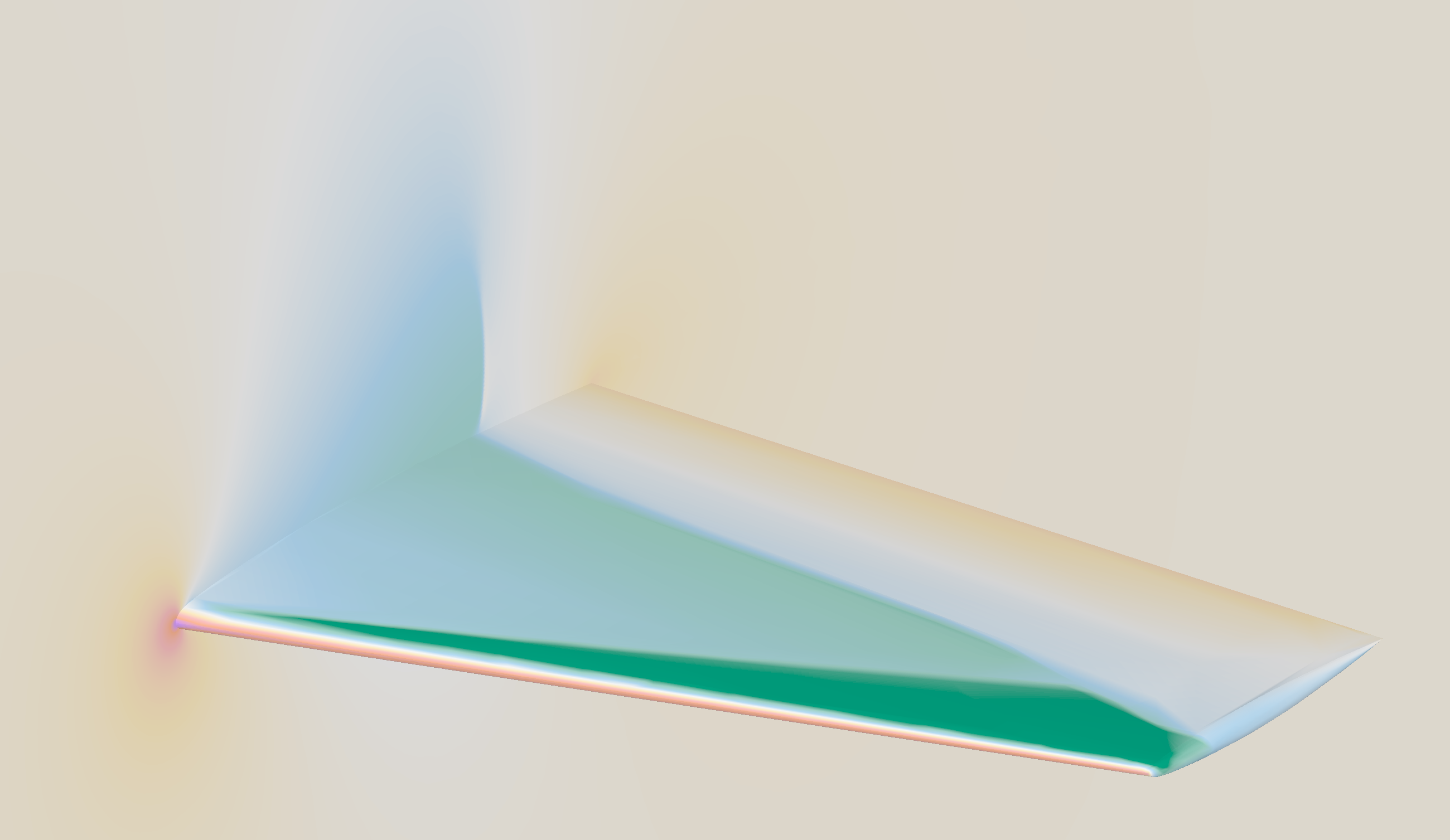
The ONERA M6 wing is a canonical transonic CFD validation case: a 30-degree swept, semi-span wing with a symmetric ONERA D airfoil section that develops a characteristic lambda shock on the upper surface, supported by classical wind-tunnel data and a multi-code NASA TMR grid-convergence study. Conditions are Mach 0.84, Reynolds number 11.72 million based on mean aerodynamic chord, and 3.06 degrees angle of attack. Four mesh refinement levels (coarse through extra-fine) are taken from the NASA Turbulence Modeling Resource ONERA M6 grid family and solved with the Spalart-Allmaras turbulence model. Grid convergence of integrated forces is assessed against reference CFD results. Surface pressure and skin friction distributions are compared against reference CFD data (FUN3D) and experiment.
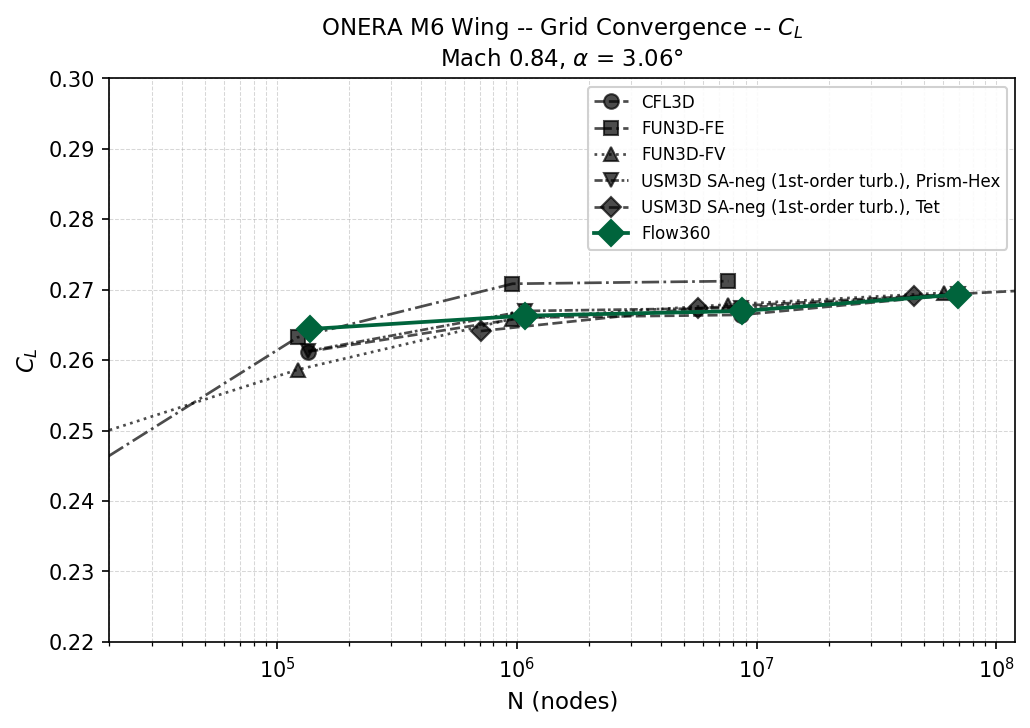
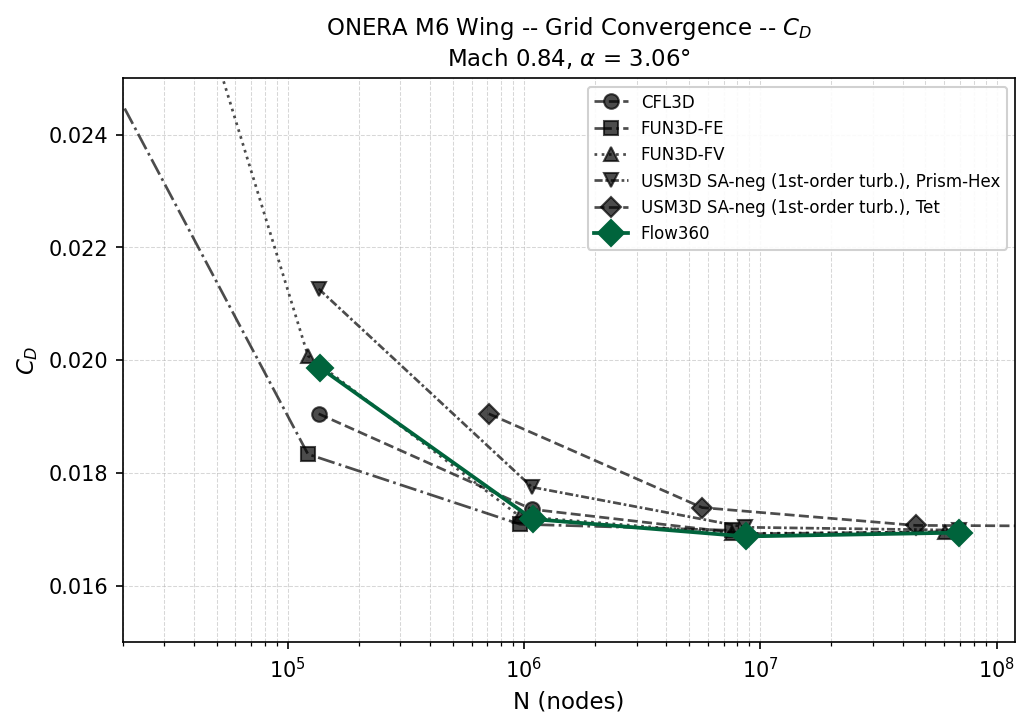
Extra-fine mesh (69.3 M nodes) Flow360 CL and CD match the matched-grid reference CFD results to within ΔCL = 3×10⁻⁴ and ΔCD = 1×10⁻⁴.
Flow360 coarse-mesh forces are closer to its own finest-mesh result than is observed for the reference CFD codes, indicating a flatter grid-convergence trend.
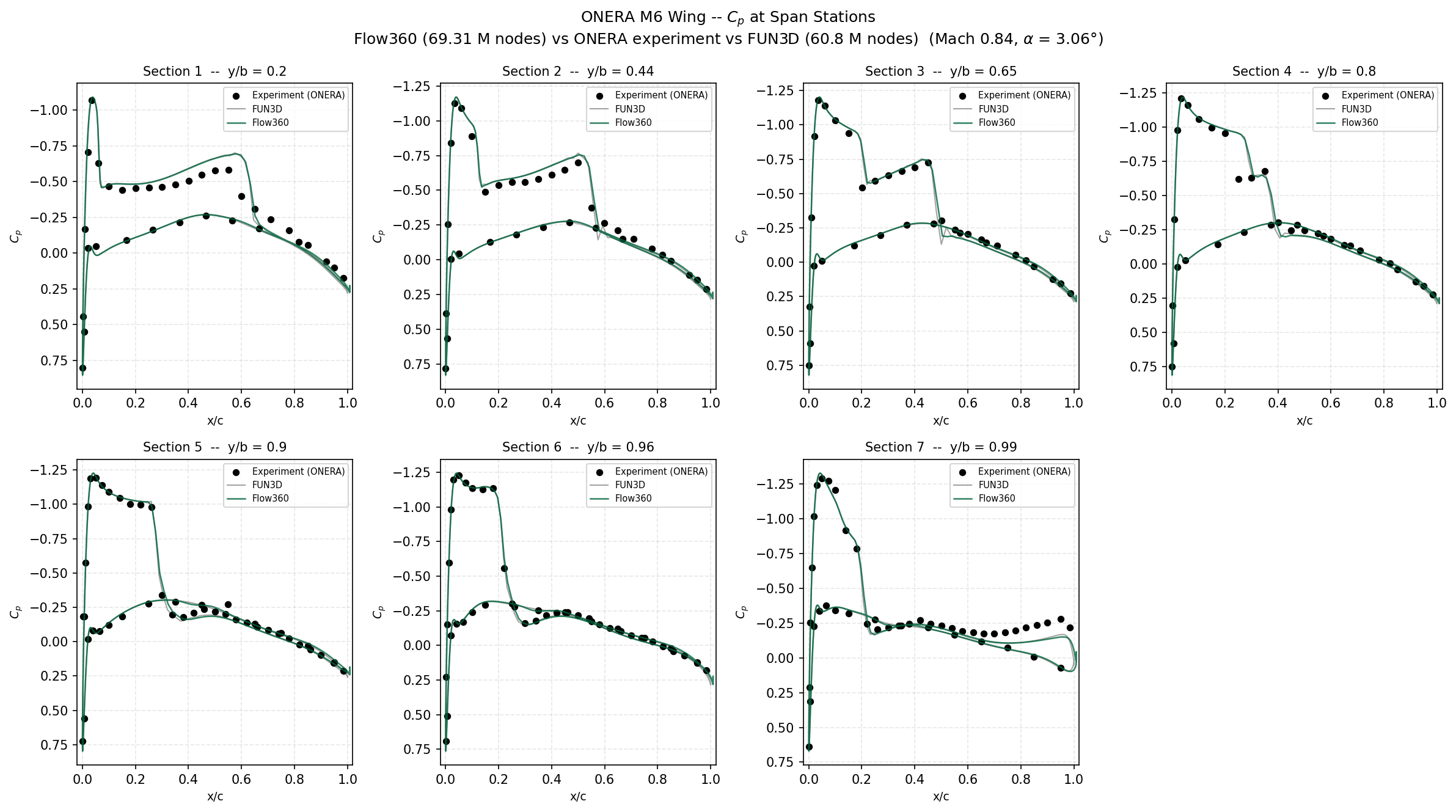
Upper-surface shock position matches FUN3D-FV within 0.01 x/c.
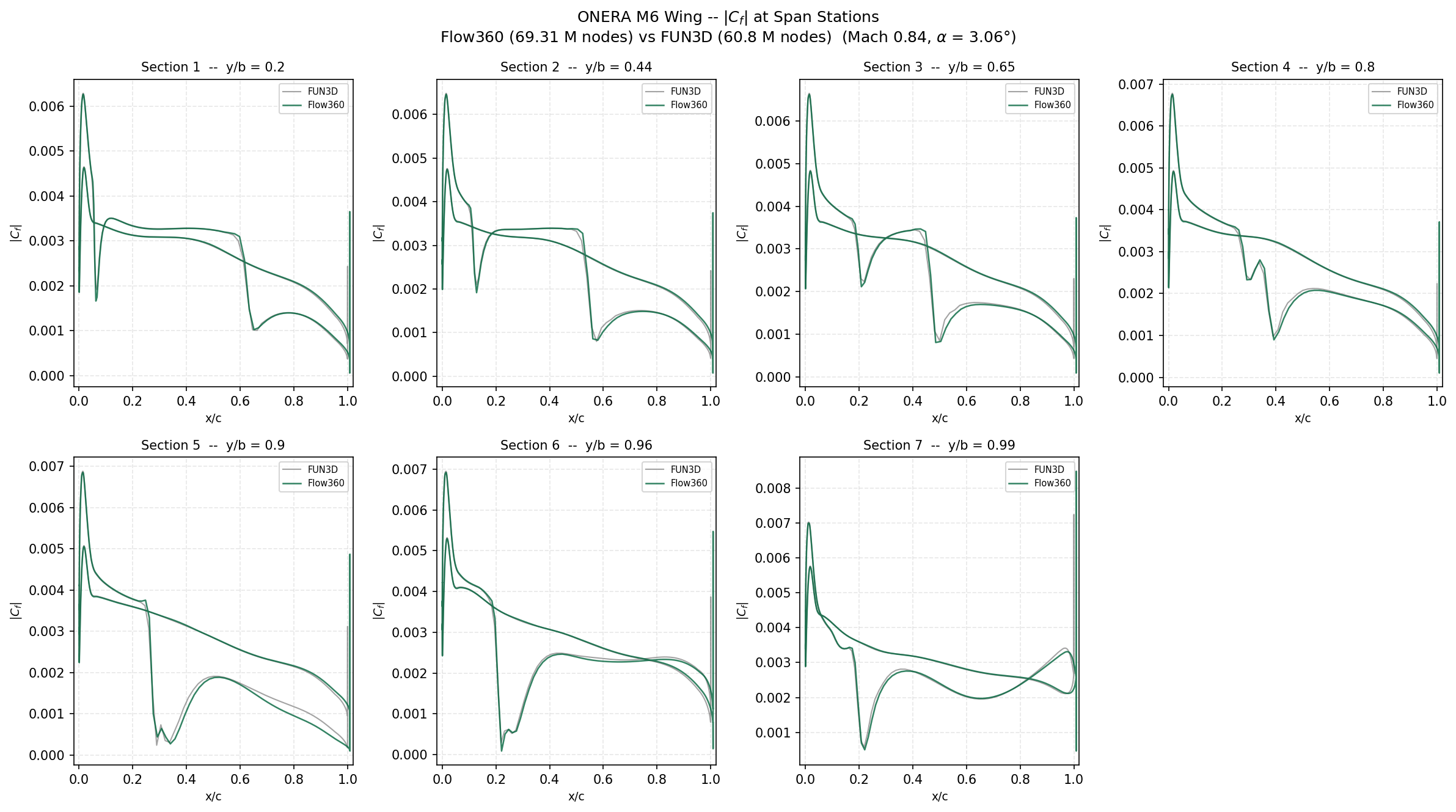
Skin-friction magnitude tracks FUN3D-FV across the upper surface at all seven span stations, including the characteristic Cf minimum at the shock foot.
Validation plots
Comparison of Flow360 predictions against reference data. Click an image to expand.
Grid convergence — CL
Grid convergence — CD
Cp slices comparison
Cf slices comparison
Solver performance
Performance is reported for the extra-fine case (69.3 M nodes), solved with the Spalart-Allmaras turbulence model and an automatic CL-based stopping criterion that ends the run once the lift coefficient has converged.