






Example Library
End-to-end notebooks taking real designs from layout to verified result. Filter by category.
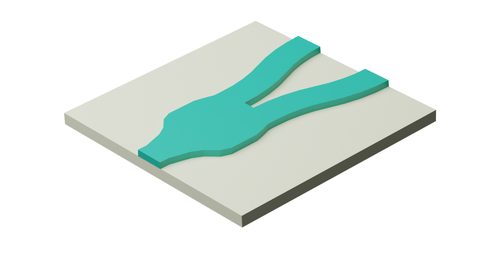
Y Splitter
This example demonstrates the use of PhotonForge to design and simulate a simple Y splitter.
Component Design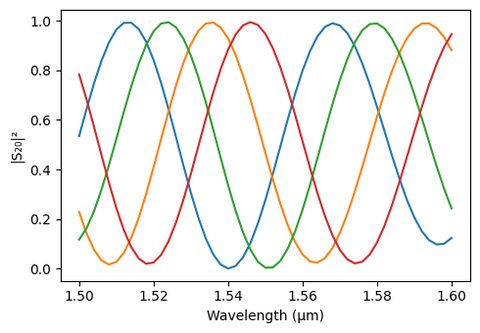
Mach-Zehnder Interferometer
This example shows the design of a simple Mach-Zehnder interferometer (MZI) to demonstrate the use of sub-components to simplify the process.
Component Design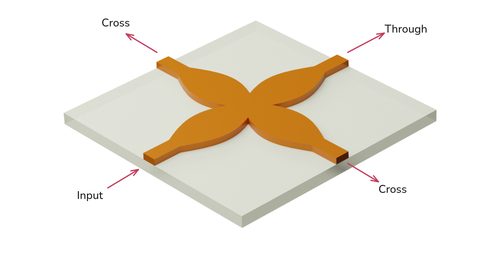
Waveguide Crossing
This example uses of PhotonForge to optimize a waveguide crossing.
Component Design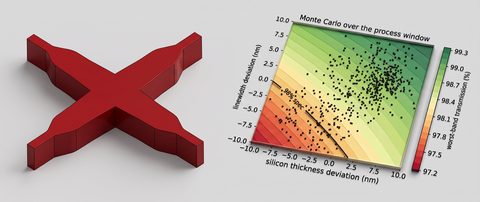
Waveguide Crossing Yield Analysis
Dense photonic circuits route hundreds of waveguide crossings, so a crossing must not only perform well at its nominal design, it must keep performing across the spread of silicon...
Component Design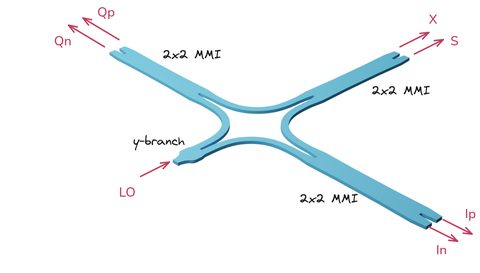
90° Optical Hybrid
In this example we construct a 90° optical hybrid.
Component Design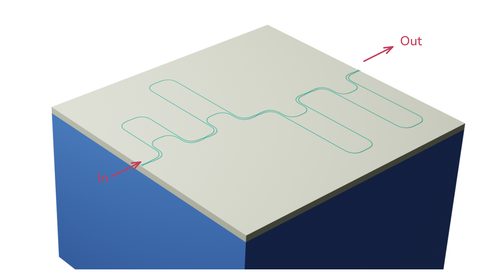
Cascaded MZI Filter
This example shows the design of a cascaded Mach-Zehnder interferometer (MZI) filter.
Component Design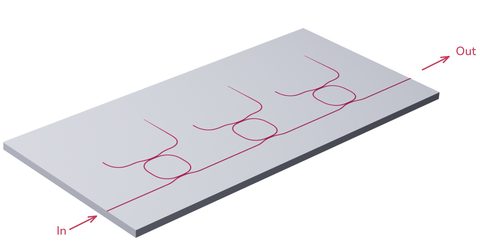
Cascaded Rings Filter
In this example, we will use a combination of component-level FDTD simulations and circuit simulations to build a filter based on cascaded ring resonators.
Component Design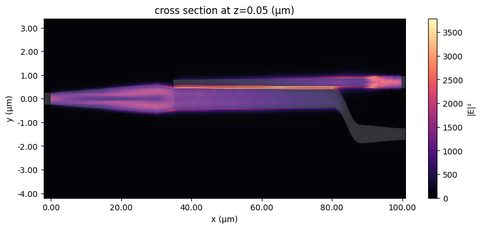
Polarization Splitter Rotator
A polarization splitter rotator (PSR) is a fundamental building block for most photonics platforms that converts between 2 orthogonal polarizations in a single waveguide (TE₀ and TM₀)...
Component Design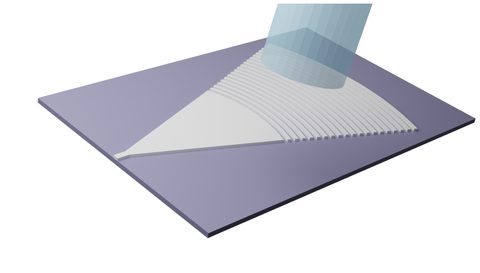
Grating Coupler
This example shows how to use the focused grating stencil to create a grating coupler component equivalent to the one demonstrated.
Component Design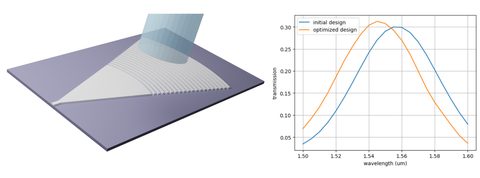
Inverse Designed Grating Coupler
In this notebook, we demonstrate fabrication-aware inverse design using PhotonForge together with Tidy3D's inverse design framework.
Component Design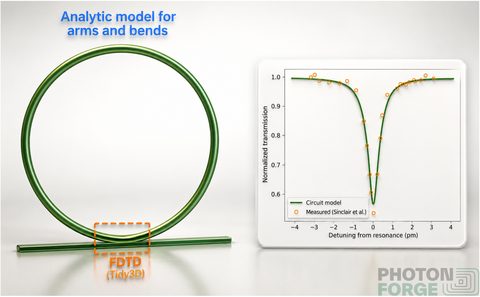
Efficient simulation of a large, high-Q micro-ring resonator
High-Q micro-ring resonators are central to many integrated-photonic systems, from narrow-linewidth lasers and filters to chip-scale atomic clocks.
Component Design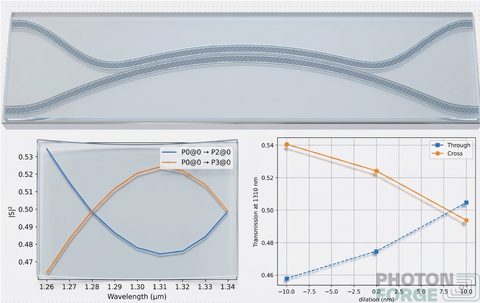
Inverse Design of a Fabrication-Robust Bent Directional Coupler
A directional coupler splits light through evanescent coupling between two adjacent waveguides.
Component Design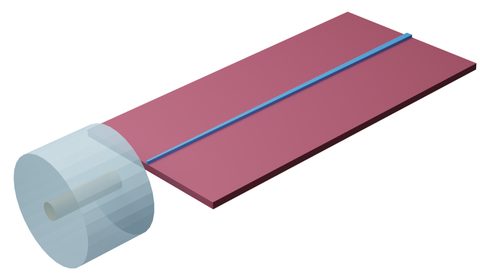
Edge Coupler
In this example, we'll explore the simulation of edge couplers using PhotonForge.
Component Design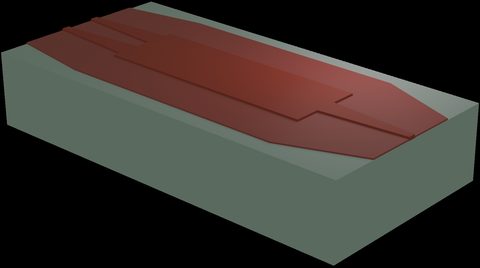
MMI Optimization with Tidy3D Design Plugin
In this notebook, we present a comprehensive workflow for optimizing photonic components within PhotonForge, combining global design-space exploration with local gradient-based refinement.
Component Design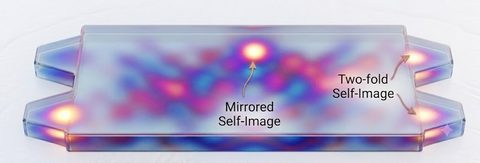
MMI 3 dB Coupler with EME
This example designs a 2x2 multimode interference (MMI) 3 dB coupler using the EMEModel, an eigenmode expansion (EME) solver.
Component Design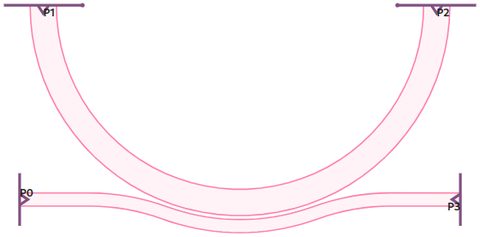
Waveguide Coupling Simulation with Port Bending
We will use the SiEPIC OpenEBL through the siepicforge module.
Component Design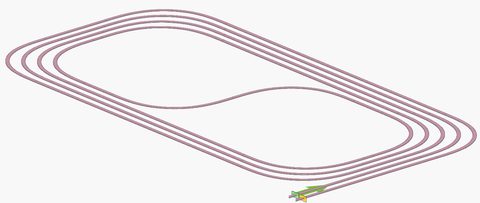
Spiral Waveguide
Simulating large photonic structures such as spirals using full-field electromagnetic methods like FDTD can be computationally expensive and time-consuming.
Component Design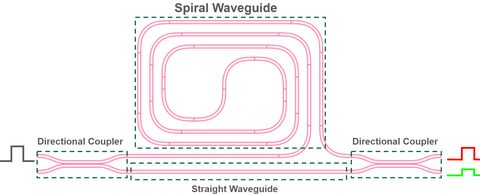
Time-Domain Simulation of a Mach–Zehnder Interferometer
In this notebook, we design and simulate a passive Mach–Zehnder Interferometer (MZI) in the time domain.
Component Design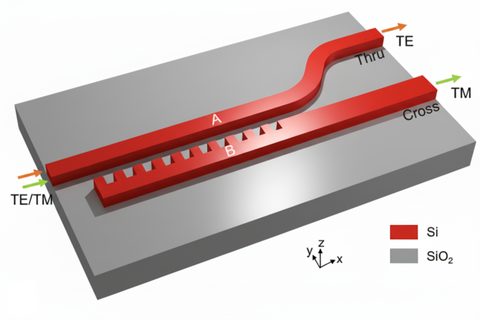
Polarizing Beam Splitter
In this notebook, we reproduce the main simulation and design results.
Component Design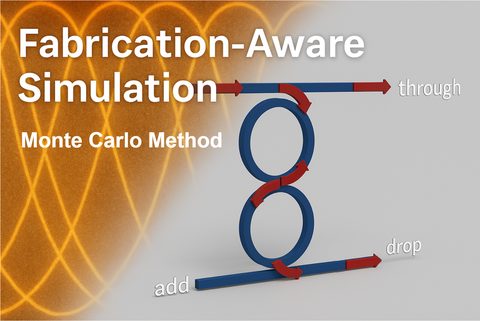
Fabrication-Aware Simulation: Two Coupled Ring Resonator Filter
In this notebook we demonstrate how we can perform fabrication-aware simulations in PhotonForge by modeling a 2-ring coupled resonator filter and running a Monte Carlo analysis on key...
Component Design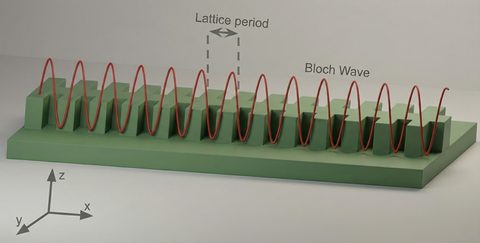
Bandstructure Analysis of 1D Periodic Waveguides
In this notebook, we study one-dimensional periodic waveguides and coupled-resonator optical waveguides (CROWs), which can be used as building blocks for high-speed silicon photonic...
Component Design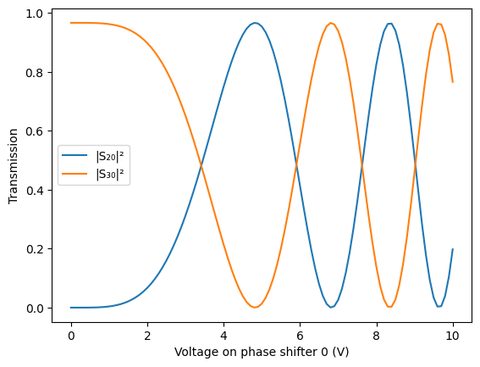
Tunable MZI
This example shows how to set up a parameter-dependent model to quickly run complex simulations under different conditions.
Active Device Design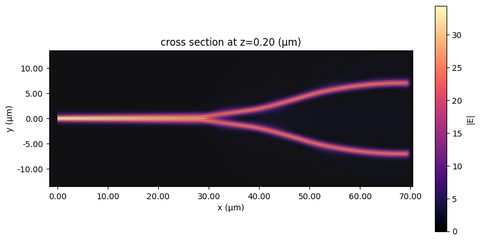
Electro-Optic Mach-Zehnder Modulator
In this notebook, we will design an electro-optic modulator based on the Pockels effect in a thin-film lithium niobate (TFLN) platform.
Active Device Design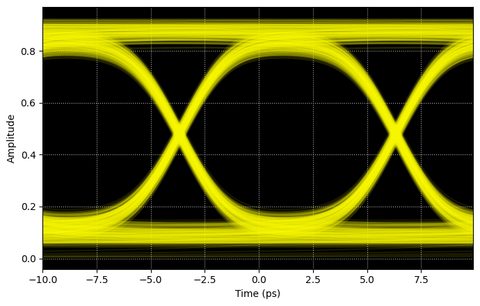
Signal Integrity Analysis of a 100 Gbps Transmitter
High-speed optical modulators, operating at data rates of >100 Gbps per wavelength channel, requires careful attention to their time-domain response, since bandwidth limitations,...
Active Device Design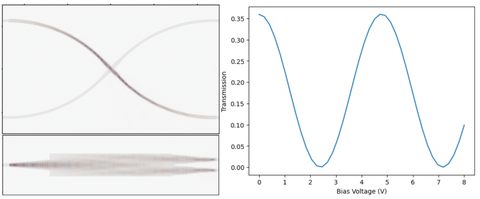
Folded Electro-Optic Modulators on TFLN: Analysis
This notebook focuses on analyzing the performance characteristics of the folded electro-optic modulator designed in the FoldedModulatorLayout.ipynb notebook.
Active Device Design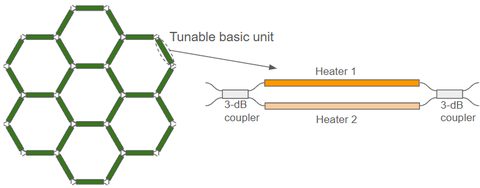
Programmable Photonic Circuit
In this notebook, we create a programmable photonic circuit inspired by the works.
Active Device Design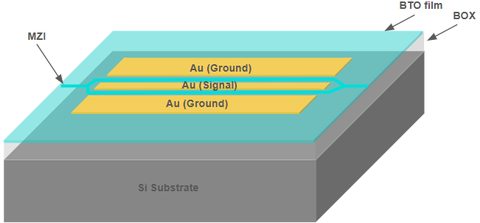
BTO Electro-Optic Modulator
In this notebook, we simulate the product of the half-wave voltage (Vπ) and the interaction length (L) for a BTO electro-optic modulator.
Active Device Design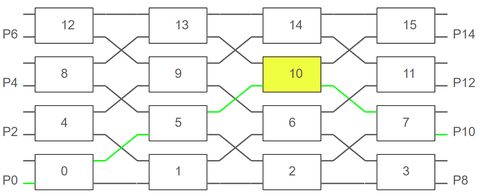
Switch Array
In this notebook, we create a switch array inspired by the work of Suzuki et al., which demonstrated a 32×32 silicon photonic switch with ultra-low insertion loss and power-efficient...
Active Device Design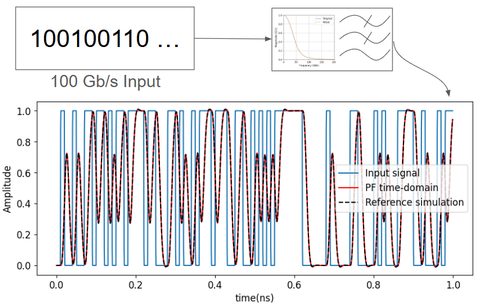
Time-Domain Simulation of a Low-Pass Filter
In this notebook, we demonstrate the workflow for simulating the time-domain response of a photonic low-pass filter (LPF) using PhotonForge.
Active Device Design
Differential Coplanar Waveguide
In this notebook, we simulate and analyze a differential coplanar waveguide (CPW) structure using both mode solving and time-domain FDTD methods within PhotonForge.
Active Device Design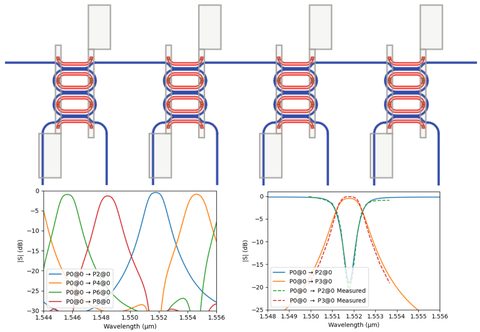
Four-Channel WDM Filter
In this notebook, we replicate the design and simulation results of a robust, fabrication-tolerant four-channel wavelength-division multiplexing (WDM) filter demonstrated.
Active Device Design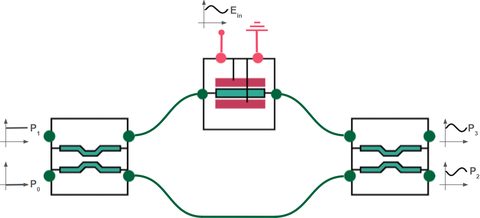
Time-Domain Simulation of a Mach–Zehnder Modulator (Toy Model)
The Mach–Zehnder Modulator (MZM) is a key component in modern optical communication systems, enabling high‑speed modulation of a continuous‑wave (CW) laser signal using an applied...
Active Device Design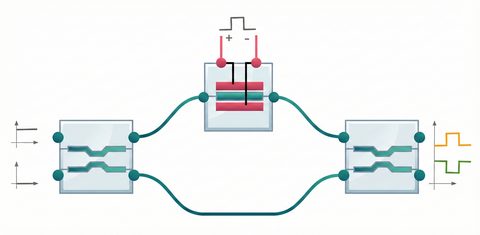
Time-Domain Simulation of a Mach–Zehnder Modulator
Mach–Zehnder modulators (MZMs) are a core building block of high-speed optical transmitters.
Active Device Design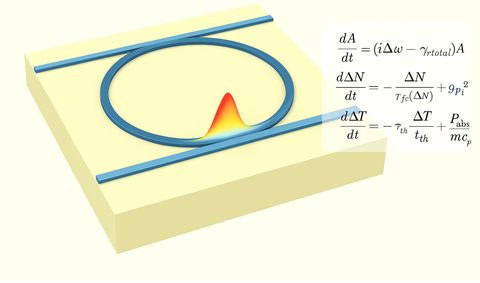
Self Pulsing in Silicon Microring Resonator
This notebook demonstrates how to build a custom time-domain model in PhotonForge by implementing the dynamics of a nonlinear silicon microring resonator as a TimeStepper.
Active Device Design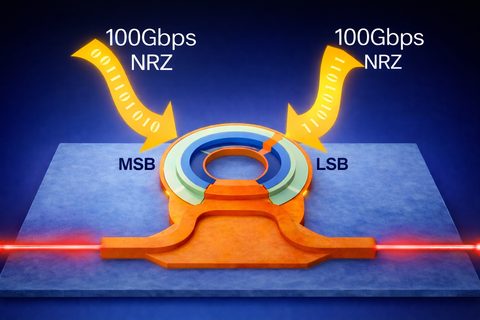
Two-Segment Silicon Microring Modulator
In this notebook, we develop a compact, physics-informed simulation replica of the two-segment silicon microring modulator.
Active Device Design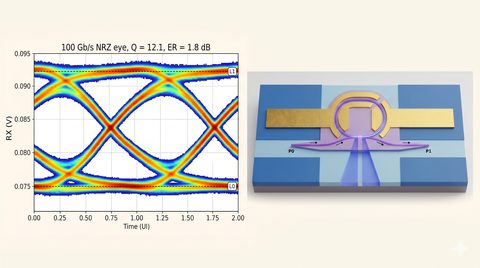
Microring Modulator: PCell with Attached Model
The silicon microring modulator (MRM) of Yuan et al. reaches 200 Gb/s per wavelength channel through a two-segment Z-shape p-n junction in the ring.
Active Device Design
3D doping extrusion from a 2D carrier profile
Importing realistic doping profiles for charge transport and electro-optic simulations is typically a non-trivial task, as the doping geometries defined in physical layouts can be highly...
Active Device Design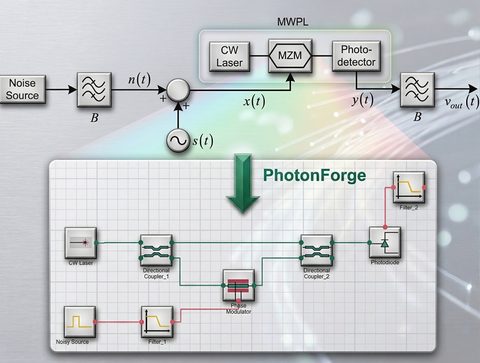
Noise Under Large-Signal Modulation
In this notebook, we will explore how to simulate and analyze the noise performance of an Intensity-Modulated Direct-Detection (IMDD) microwave photonic link.
Active Device Design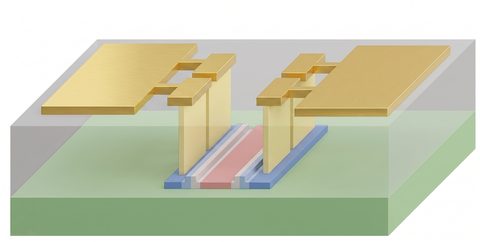
Series Push-Pull Mach-Zehnder Modulator with Slow-Wave T-Rail Electrodes
This notebook simulates a silicon-photonic carrier-depletion Mach-Zehnder modulator (MZM) using slow-wave coplanar-strip (CPS) electrodes with periodic T-shaped extensions, and connects...
Active Device Design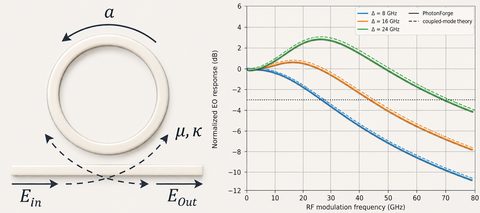
Optical Peaking in a Microring Modulator
The small-signal electro-optic (EO) response of a microring modulator is not a simple low-pass set by the photon lifetime: when the laser is detuned from the cavity resonance, a resonant...
Active Device Design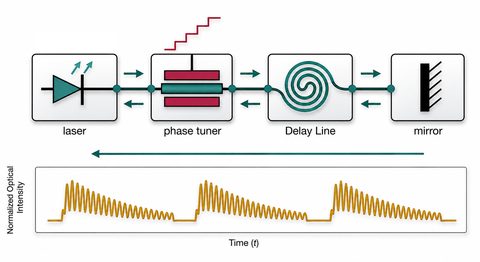
Laser Dynamics with External Optical Feedback
A semiconductor laser that receives a delayed reflection of its own light is a delay dynamical system.
Active Device Design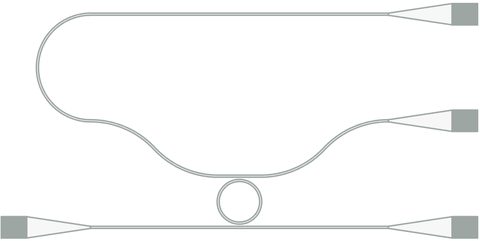
Add-Drop Filter Layout
This notebook demonstrates how to create a basic add-drop filter layout using PhotonForge.
Full Chip Layout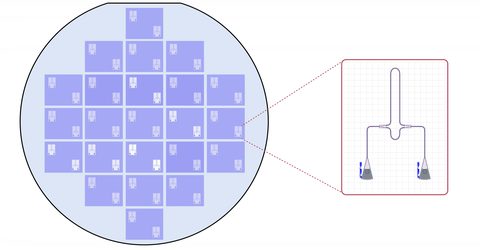
Building Circuit Models from Layout Files
In this notebook, we will see how to load GDSII layouts and run both component- and circuit-level simulations.
Full Chip Layout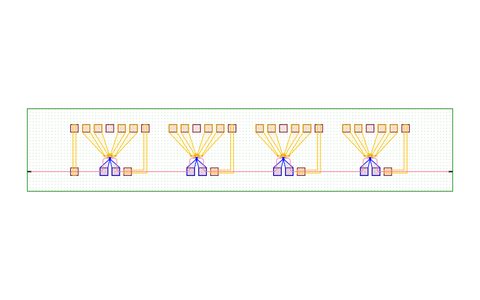
Microring Modulator
In this notebook, we show the layout for a 5×200 Gbps microring modulator chip derived from the works by Yuan et al.
Full Chip Layout
Dual Polarization IQ Modulator
This example will show how to build and route a dual polarization IQ modulator using the SiEPIC OpenEBL photonics platform.
Full Chip Layout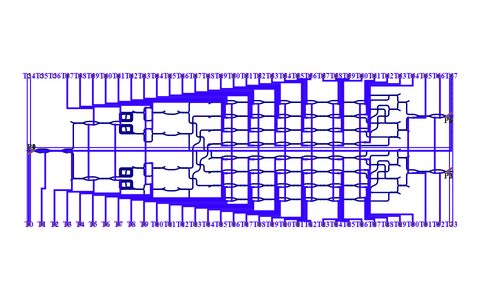
Quantum Chip
This notebook is an example for full-chip layout and routing using PhotonForge.
Full Chip Layout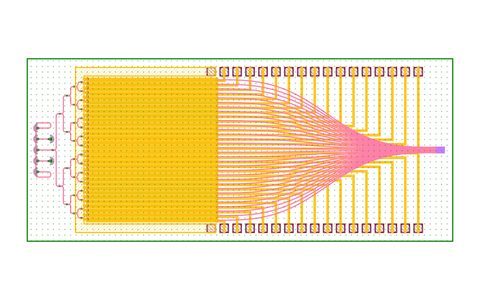
LIDAR
In this notebook, we build a basic LIDAR chip inspired by the design in the works of Wang et al. using the SiEPIC OpenEBL PDK.
Full Chip Layout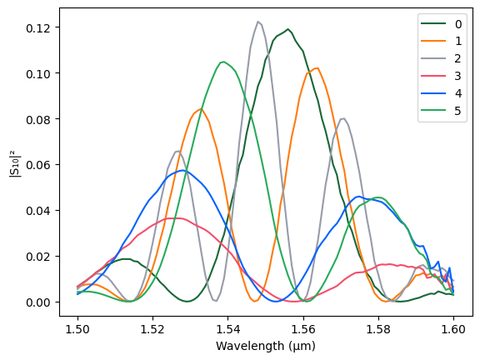
Foundry-Compatible PIC Design Flow
We begin by loading PhotonForge, Tidy3D, the SiEPIC OpenEBL PDK, and other common Python modules we will be using.
Full Chip Layout
Folded Electro-Optic Modulators on TFLN: Layout
This notebook provides a step-by-step guide for generating the circuit layout of folded electro-optical modulators based on a thin-film lithium niobate (TFLN) platform.
Full Chip Layout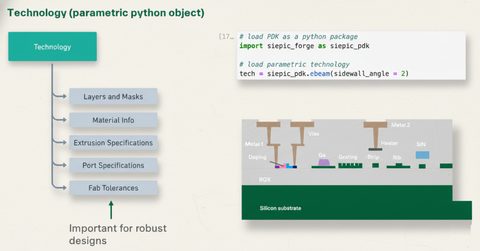
Technology and PDK Setup
This notebook builds a custom SiEPIC EBeam technology stack (PDK “technology”) intended for high-speed RF photonics work (modulators, transceivers), then validates/visualizes it.
Datacom Chip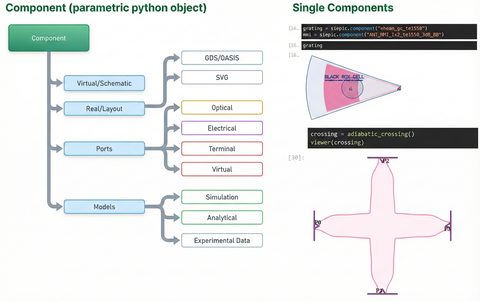
Custom Component Library
PhotonForge components are PCells (parameterized cells).
Datacom Chip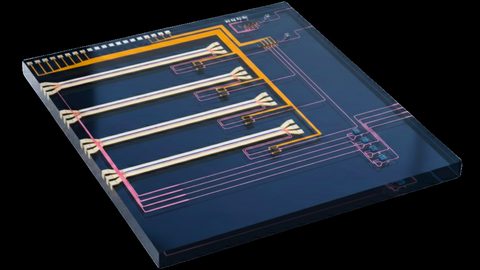
Chip Layout
This notebook assembles the 800G transmitter PIC layout by composing the reusable building blocks defined in ComponentLibrary.ipynb into hierarchical sub-modules:.
Datacom Chip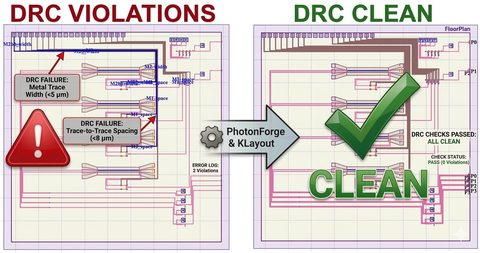
Design Rule Check
After finalizing the physical layout of the 800G transceiver chip, the Design Rule Check (DRC) serves as the critical bridge between digital design and physical manufacturing.
Datacom Chip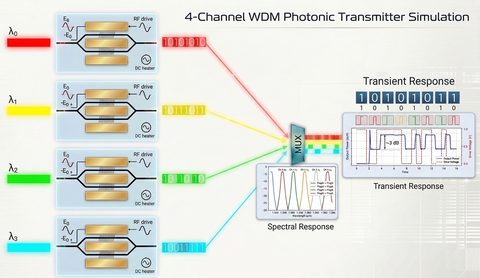
Chip Simulation
This notebook details the simulation phase of the tutorial series.
Datacom Chip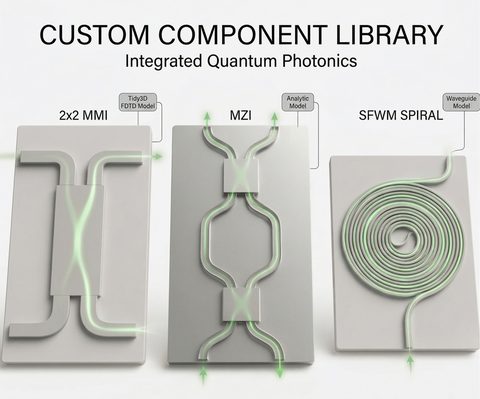
Custom Component Library
This notebook defines a comprehensive library of parameterized photonic components used in the layout and simulation of our quantum chip.
Quantum Chip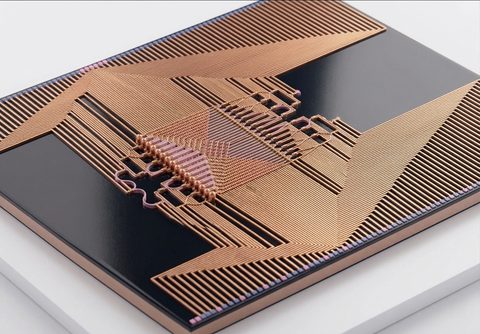
Quantum Chip Layout
This notebook demonstrates the layout phase of a photonic quantum chip design.
Quantum Chip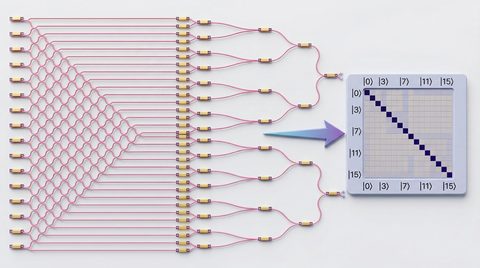
Quantum Chip Simulation
This notebook implements a generalized, physics-accurate simulation of a programmable quantum photonic processor.
Quantum Chip

 TERMS & CONDITIONS


 How the process works:
 Try this real URL to see an example: